

GMBS
SELF-ASSESSMENT REPORT
Provider Licensing
INTRODUCTION
GMBS MISSION, MAIN OBJECTIVES AND LONG-TERM PLAN
1. The main mission of the GMBS is:
(a) Providing, organising and ensuring higher education in the accredited online study programmes;
(b) Pursuing creative scientific research;
(c) Providing further postgraduate and lifelong learning through a wide range of courses and educational activities.
This also includes teaching students the fundamental principles of business, developing their critical thinking and analytical skills, and preparing them to succeed in a competitive global marketplace. GMBS also focuses on promoting ethical educational and business practices, promoting social responsibility, and encouraging innovation and entrepreneurship. In addition, GMBS works with various partners to create internship, networking and career development opportunities for its students. Ultimately, GMBS's core mission is to prepare future leaders who will be able to drive the success of the organization and contribute to the overall economic development of society.
2. The GMBS is a private higher education institution that provides, organizes and ensures higher education and research in its accredited MQF 5-8 degree programmes.
3. The GMBS focuses on education, research, and the production and dissemination of innovations in a wide range of the applied study programmes and scientific disciplines, with an emphasis on the training of professionals in particular demand across the labour market, in order to contribute to building an educated society. The GMBS is open to students from all over the world, including those with special needs, and strictly adheres to the equal rights of all. Teaching, learning and curriculum are adapted to online learning and developed based on the latest knowledge and best pedagogical practices with a student-centred focus.
4. The GMBS cooperates with domestic and foreign higher education institutions and universities, the business sphere, the public sector, NGOs, and is active in the international projects and mobilities. The forms and modalities of cooperation and mobility are governed by contracts. All cooperation partners must comply with the GMBS internal quality assurance system.
5. The GMBS pursues its mission in educational and research activities independently and freely. Academic rights and freedoms shall be exercised in accordance with the principles of democracy, humanity and EU law.
6. The specification of the objectives and the measures to achieve them, resulting from the mission of GMBS, is contained in the "GMBS Long-Term Plan" document.
7. The Academic Senate approves the Long-Term Plan submitted by the Board of Directors, after it having been discussed in the Scientific Council. The GMBS Long-Term Plan is an open document and is updated, as necessary.
INSTITUTIONAL ACCREDITATION
1 MISSION AND STRATEGIC MANAGEMENT
MISSION OF THE GMBS
The main mission of GMBS is to provide, organize and secure higher education in its accredited online study programmes, to carry out creative scientific research, and to provide further education through a wide range of courses and educational activities. The GMBS focuses on the production and dissemination of knowledge and innovation, especially in applied study programmes and scientific disciplines, with an emphasis on the training of professionals in demand across the labour market, with the aim of contributing to building a knowledge-based and sustainably competitive economy. To this end, the GMBS cooperates with domestic and foreign higher education institutions and universities, the business sphere, the public sector and NGOs, and participates in international projects. Another mission of GMBS is to conduct scientific inquiry, and both basic and applied research. The GMBS is also an educational institution; its activities greatly influence the personal growth of its students, thereby significantly affecting the character of our society and preparing the future shape of its development. This mission has been fulfilled mainly in the framework of targeted international, EU, cross-border and regional cooperation. The GMBS provides an unbiased space for free dialogue; it is an effective tool for safeguarding and promoting understanding and cohesion at the regional, national and international levels, as well as in different spheres of life and disciplines. The GMBS develops quality in all its processes and activities. The GMBS promotes innovation and necessary changes in order to:
- Develop knowledge and scholarship based on creative research for a new quality of professional level;
- Educate and train professionals with the knowledge, skills and competences that will enable them to become successfully integrated into the labour market.
The GMBS operates as an independent and free higher education institution delivering educational programmes at an internationally comparable level. The GMBS provides higher education at MQF/EQF levels 5-8. The GMBS contributes to enhancing the competitiveness and employability of graduates in the increasingly competitive environment of an integrating and globalizing world. In the implementation of its mission and objectives, the GMBS relies on the requirements and objectives arising from the national and international documents, and agreements and programmes from across the European educational and scientific research area. The GMBS teaching staff produce scientific results of societal significance, thus becoming an authentic source of knowledge and experience for students in their educational pursuits. The GMBS supports all measures leading to objectivity and fairness of the evaluation criteria, but also those to avoid discrimination. The GMBS is an open higher education institution in terms of its purposeful focus on the concrete development of domestic and international external relations as a quality and publicly known institution, with its own attractive offerings and a widely accessible space for the search for answers in free dialogue. It aims to be an increasingly useful partner institution in society.
STRATEGY AND DEVELOPMENT OBJECTIVES
The strategic goals of the GMBS management, with the participation of the entire academic community, are oriented towards:
- Linking students' theoretical education with their active participation in the solution of
scientific and research projects and their presentation;
- Education of students that strengthens learning at all levels and reinforces
humanism, tolerance, moral and ethical values;
- Information flows and information within the core, management and support processes
oriented towards ensuring information completeness for all members of the academic community
and non-teaching staff at the GMBS;
- Teaching standards for the individual study programmes and subjects of study, which are
developed in the context of the GMBS development strategy;
- Extensive, quantitative, as well as intensive, qualitative growth in science and education as
the main activities of GMBS;
- Focus on the preparation of GMBS studies, in particular on the study programmes development in response to the requirements of practice and the labour market, with specialization for practice, accompanied by a high-quality and unified website for the GMBS and its components;
- Research-oriented higher education institution as an educational institution of a predominantly pedagogical, humanitarian and social nature, with a broader background in other areas of science;
- The implementation of doctoral studies at a high international level − the provision of GMBS staff resources with their own specificities;
- Institutionalized interaction of the GMBS within the region and abroad;
- Clear identification and tools for the development of GMBS specificities;
- Respecting the objectives of the Bologna Process and the conclusions of the Bologna Declaration, promoting mobility to enable students to benefit linguistically, culturally and educationally within the European Area;
- Success in applying for and obtaining grants in science and research with the implementation of their outputs into social practice;
- The introduction of the latest ICT technologies, particularly in the area of online learning, as an important support to the information literacy skills of staff and students;
- Intensive cooperation with foreign educational institutions in the implementation of joint education in the accredited study programmes that are aimed at improving quality and professionalism with the necessary international experience;
- Leading activities in the field of education and training of students in the process of online learning, independent creative work, creativity and innovation with the strengthening of internationalization and interdisciplinary approach in the education and research work of lecturers and students;
- Improving the qualification structure of teaching staff so that the GMBS is prepared for innovation for its study programmes and staffing with an adequate number of qualified lecturers.
PRIORITIES
- The concept of the entire operation of the GMBS and its specificity is in the deepest and broadest sense based on a principle of recognition and protection of values in education and training, as well as on scientific and research activity, the essence of which is the understanding of the objectivity of a meaningful existential starting point, as opposed to the relativistic view of the reality of life.
- Quality in all areas of GMBS activities, especially in online education, training, and scientific and research activities, is indispensable for its stability, sustainable growth, international cooperation, influence and prosperity, as well as for the employment of its graduates.
- Effective value protection and quality assurance at the GMBS must be accompanied by a constant preferential interest in achieving sustainability and development of its material and economic conditions which, above all, ensure the quality and dignity of the work of staff and students.
- Linking theory and practice and implementing the latest scientific results directly into educational activities and involving students in projects.
MAIN TASKS
The main tasks of the GMBS management will be oriented towards the fulfilment of the mission, strategy and improvement of its internal quality system in accordance with the criteria of its assessment of the Malta Further and Higher Education Authority (MFHEA) and internationally recognised quality standards. The GMBS will: continuously monitor and evaluate quality indicators from the internal and external environment of the GMBS, identify weaknesses and take action to address them; Improve the internal system of quality education and career care for lecturers and staff at the GMBS in order to develop their skills and update their knowledge in all areas of work; Orient the comprehensive human resources development programme preferably towards the improvement of qualifications, digital skills, independent creative scientific research and publishing work, and the development of talent and creativity of all members of the academic community.
The GMBS implements the main tasks of its long-term plan through its departments with the focus on:
- Establishing a professional and expert institution capable of drawing up strategic plans and coordinating the development of society;
- Creating links of mutually beneficial cooperation towards other state, public and private higher education institutions with a similar focus, as well as with foreign educational and scientific research institutions;
- Purpose-driven cooperation with other educational, research and economic institutions to develop new study programmes and a European education and research area;
- Creating the institutional, organisational and professional conditions for the development and innovation of study programmes with their own scientific research and exploration work aimed at the development of the relevant field of study;
- Building centres of excellence and project groups for international research cooperation;
- Developing scientific research in the light of developments and economic conditions in other EU countries;
- Active participation of the teaching and science and research staff from the institution in the public debate related to the formation of a modern democratic and rule of law-based state;
- Creating the right conditions for improving the professionalism of students;
- Professional development and stabilisation of staff; regular evaluation of performance and quality of work, and differentiation of pay according to performance and quality of work.
EDUCATION
The areas of educational activity at the GMBS are oriented, in terms of their content and methodology, towards the preparation of higher educated professionals in their field. Emphasis is placed on knowledge, expertise and competences acquired in connection with their own scientific research activities and cooperation with social practice at home and abroad. As part of the Long-Term Plan, the GMBS will focus on the following in the field of education:
- Accredited study programmes at MQF/EQF levels 5-8;
- Preparation of accreditation and subsequent implementation of new study programmes;
- Preparation, maintenance, training and continuous improvement and use of the best methods in the field of online education;
- All-round modernisation and computerisation of the teaching process with regard to online learning;
- Encouraging students to participate in domestic and international projects;
- Organizing scientific conferences and competitions of scientific and artistic works of students;
- Innovation of all teaching materials in connection with innovation in subject content and the overall modernization of the educational process taking into account the best and latest knowledge in online education;
- Improving the quality of staffing for the training of qualified lecturers; − Introduction and development of new forms and methods of education, e-learning, promoting creative work and communication between students and lecturers;
- A high level of care for applicants and students with specific needs;
- Monitoring the acceptability of graduates by employers and their placement on the labour market, if possible;
- Regular evaluation of the quality of the educational process to carry out teaching-observation and audit activities and to take measures to eliminate any identified shortcomings;
- Implementing the process of ensuring and improving the quality of the educational process with the promotion and application of modern methods of online education and their feedback.
SCIENCE AND RESEARCH
The 21st century is bringing enormous opportunities for the implementation of the latest technical advances and electronic systems in research and education, which have so far been used in a rather passive and user-oriented form without the application of creative methods. The increasing importance of science and research in the evaluation of higher education institutions in the context of the EU education and scientific-research area has a significant impact on the position of the GMBS and the impact on the transparent evaluation of the quality of the GMBS departments and staff from an international perspective. As part of the Long-Term Plan, the GMBS will focus on the following in the field of science and research:
- Intensification of work in obtaining and implementing projects and grants from domestic and foreign grant agencies;
- Supporting the career development of scientific and teaching staff; focusing on improving research skills and intensifying quality outputs from ongoing projects and grants, as well as international cooperation;
- Improving the level of scientific outputs of the scientific and teaching staff in scientific journals;
- Fostering innovation and creativity of staff and students, a space for the exchange of knowledge and experience at both national and international levels;
- Organising international scientific conferences in individual areas of research at the GMBS and ensuring the transfer of conference conclusions into practice.
INTERNATIONALISATION AND COOPERATION WITH SOCIAL PRACTICE
The development of quality educational and scientific research activities at the current state of knowledge can only be implemented in an environment of international cooperation, and cooperation with bodies and institutions of social practice. The prerequisite for cooperation is participation in foreign projects, participation in the joint publication of monographs, textbooks and scientific articles, the organisation of conferences and seminars, and participation in events with international attendance, with a transfer of knowledge and experience presented in the internationally recognized scientific publications. The Long-Term Plan in the field of international relations and cooperation with social practice will focus on:
- Intensifying the contractual and informal relations with our partner European and non-European institutions of strategic importance to the GMBS;
- Increasing the emphasis on the quality of the GMBS international relations by strengthened creation of conditions for increasing the number of students from all around the world studying at the GMBS, and by offering study programmes in foreign languages;
- Support for the GMBS mobility, in particular in the framework of cooperation with the major foreign partner institutions;
- Strengthening the attractiveness of the GMBS by further expanding international cooperation;
- Involving students, teaching, research and administrative staff working at partner institutions in the presentation of the GMBS abroad;
- Fostering bilateral relations within and focusing on the promotion of study and creating appropriate conditions for the admission of foreign students, lecturers, scientists and artists;
- Continuing in concluding new agreements with attractive educational and scientific institutions abroad aimed at entering into joint projects and creating joint study programmes based on the award of joint diplomas for the graduates of these programmes;
- Ensuring the active participation of the GMBS and its academic staff in international associations and organisations with international participation.
- Closing regional gaps through education and business development by building and improving the work of regional education and business development centres.
INTEGRATED FRAMEWORK FOR STRATEGIC GOVERNANCE, FINANCIAL PLANNING, AND RISK MANAGEMENT
GMBS implements an integrated governance model that combines long-term strategic planning with practical implementation, financial resource allocation, and institutional risk management.
The cornerstone of this system is the Long-Term Plan, which defines the vision, mission, and major development priorities of GMBS over the medium to long term. This plan outlines the institution's key activities and strategic intentions, which are further elaborated through the Business Plan.
The Business Plan translates strategic goals into actionable components, specifying Key Performance Indicators (KPIs), responsibilities, timelines, and expected outcomes. These are aligned with academic programmes, target groups, and broader institutional objectives.
Implementation of these activities is financially supported by the annually prepared Financial Plan, which is developed through an internally documented and transparent budgeting process and approved by the Board of Directors. The financial plan ensures:
-
Sustainable financing of educational, research, and support operations,
-
Advancement of digital infrastructure and academic quality,
-
Execution of priorities defined in both the Long-Term Plan and Business Plan.
In parallel, GMBS has adopted a formal Business Continuity Plan (BCP), aimed at ensuring institutional resilience in the face of disruptions. This plan includes:
-
Identification and assessment of major institutional risks,
-
Preventive and mitigation measures (e.g., data backup, alternative teaching channels),
-
Defined communication protocols and responsibility structures during crisis events,
-
Periodic testing and revision of recovery scenarios.
Through this interconnected framework, GMBS guarantees the effective implementation of its strategic objectives, sustainable resource allocation, and institutional preparedness for unforeseen challenges.
🟩 Evaluation of Compliance with Minimal Indicators – Standard 1
Indicator Evaluation Justification
1.1. The institutional mission is concise, clear, and aligned with strategic planning.
Fully compliant
The mission of GMBS is clearly defined in the opening sections of the Long-Term Plan, emphasizing the provision of quality online higher education, research, and the development of professional competencies. This mission is directly aligned with the development priorities outlined in the same document, thus ensuring its integration into strategic management.
1.2. The institution has a strategic development plan that is measurable, time-bound, and achievable.
Fully compliant
The Long-Term Plan outlines structured development areas: education, research, internationalisation, and cooperation with practice. These are supported by specific objectives such as the implementation of new programmes, development of infrastructure, or engagement in international research. Measurable goals (e.g., number of programmes, mobilities, projects) are further detailed in the Business Plan.
1.3. There is an operational plan which describes future activities derived from the strategic plan, sets Key Performance Indicators (KPIs) and timelines together with resources needed for their implementation, and defines the responsibility for implementation of the goals.
Fully compliant
Although GMBS does not explicitly label a document as an "operational plan," this function is fully covered in the Business Plan and Financial Plan, where activities aligned with the Long-Term Plan are detailed through measurable objectives (KPIs), implementation responsibilities, deadlines, and associated resources.
1.4. The allocation of the institutional financial resources is done through a transparent budgeting process and is aligned to the strategic and operational plans.
Fully compliant
The budget allocation process is described in the Financial Plan: an annual budget is prepared with departmental input and formally approved by the Board of Directors, as stated in the GMBS Quality Manual (7.1.1). The budget clearly reflects priorities from the Long-Term Plan and supports actions defined in the Business Plan. Transparency and strategic alignment are demonstrable.
1.5. The institution has a plan that ensures the business continuity of all its major processes. The plan takes into account all possible risks and mechanisms for their prevention as well as strategies for risk assessment and mitigation.
Fully compliant
GMBS has a dedicated Business Continuity Plan, which includes risk identification (e.g., service outages, staffing shortages, cyberattacks), mitigation strategies (e.g., backups, substitute teaching solutions, cloud-based systems), assigned responsibilities, and communication protocols. This plan is grounded in a documented Risk Analysis.
Indicative evidence in connection with the minimal indicators (MI):
- Long-Term Plan (MI 1.1, 1.2)
- Organisational Regulations (MI 1.3, 1.5)
- Quality Manual (MI 1.2, 1.3, 1.4, 1.5)
- Statutes (MI 1.1, 1.2, 1.3, 1.4, 1.5)
- Internal Quality Assurance System (MI 1.1, 1.2, 1.3, 1.4, 1.5)
- Quality Policy (MI 1.1, 1.2)
- Business Continuity Plan (MI 1.5)
- Risk Analysis (MI 1.3, 1.4, 1.5)
- Business Plan (MI 1.1, 1.2, 1.3, 1.4, 1.5)
- External and Internal Factors, Steakholders and their Reqiurements (MI 1.5)
- Financial Plan (MI 1.2, 1.3, 1.4, 1.5)
🧭 SWOT analysis:
Strengths:
- Important mission: The GMBS has a clear and significant mission in the provision of online higher education, scietific research and the training of professionals for the labour market.
- Quality orientation: The GMBS is committed to developing and maintaining high quality standards in all its activities, especially in the field of online education, which can strengthen its position in the education market.
Weaknesses:
- The need to continuously improve its attractiveness for international students and partners: Although the GMBS has international ambitions, it may need to increase its attractiveness to international students and partnerships with other institutions.
Opportunities:
- The growing importance of science and research: With an increasing emphasis on research and innovation, the GMBS can increase its presence and impact by strengthening scientific research and increasing the number of grants and projects.
- Increased internationalisation: The world is becoming increasingly globalised, providing the GMBS with an opportunity to increase its international presence and attractiveness to students and partners from around the world.
Threats:
- Competition: Competition in higher education is fierce and the GMBS must ensure that it remains relevant and competitive with other institutions.
- Changes in the regulatory environment: Changes in the national and international legislation may affect funding, accreditation and other aspects of the GMBS activities. It is important to monitor, and adapt to, these changes.
Compliance level: Fully compliant
2 GOVERNANCE, ORGANISATIONAL STRUCTURE AND ADMINISTRATION
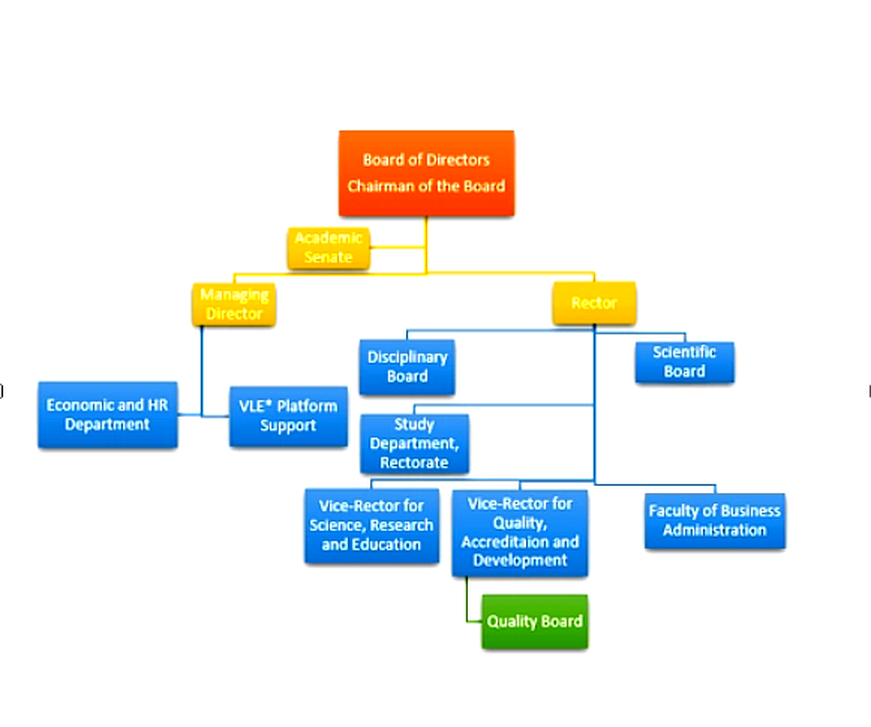
MANAGEMENT OF GMBS
- The management of the GMBS is carried out by its bodies.
- The bodies of the GMBS are:
(a) Managing bodies:
(1) Board of Directors
(2) Chairman of the Board of Directors
(b) Academic self-government bodies:
(1) Academic Senate
(2) Rector, Vice-Rectors
(3) Scientific Council
(4) Disciplinary Committee
Indicative evidence:
- Rules of Organisation
- The GMBS Academic Senate Election Principles
- Rules of Procedure of the Academic Senate
- Rules of Procedure of the Scientific Council
- Rules of Procedure of the Disciplinary Board
- Statutes
A key managerial post dedicated to the management of online and blended learning from an educational (Vice-Rector for Quality, Accreditation and Development) and technical (VLE platform support) point of view is included in the GMBS organizational structure.
Adequate resources are provided to support the technical infrastructure, training, and systems necessary for online learning.
Indicative evidence:
🟩 Evaluation of Compliance with Minimal Indicators – Standard 2
Indicator Evaluation Justification
2.1 The procedures and criteria for the election/appointment of leadership positions and governance bodies are clearly defined in institutional regulations and made transparent to the academic community of the institution.
Fully Compliant
The procedures for the election and appointment of GMBS governing bodies are clearly defined in documents such as the Statutes, Rules of Procedure of the Academic Senate and Rules of Procedure of the Scientific Council. The election principles are publicly available and ensure transparency.
2.2 The persons occupying leadership positions and those sitting on senior governance bodies are qualified and fit for the responsibilities of their roles.
Fully Compliant
All key leadership positions are held by qualified experts. In addition to the Rector, Vice-Rectors, Chair of the Board of Directors, and members of the Academic Senate, other roles such as the Vice-Rector for Quality, Accreditation and Development (responsible for online learning from an academic perspective) and technical support for the VLE platform are included in the formal Organisational Structure.
2.3 Provisions are made for membership of governance bodies to include representatives of all stakeholders – students, academic and administrative staff and, where possible, representatives of the labour market.
Fully Compliant
Stakeholders are involved in governance: students are represented in the Academic Senate; academic and administrative staff are also included. Labour market representatives are regularly invited to participate in programme design and evaluation processes as external consultants.
2.4 There is a formally adopted organisational structure where governance, decision-making, and distribution of responsibilities of all levels and units are clearly defined in an achievable and realistic manner.
Fully Compliant
The formal Organisational Structure of GMBS is described in detail in the Organisational Regulations. The responsibilities of all management and self-governing bodies are further defined in the Statutes and Quality Manual. The structure includes specific roles for digital learning, ensuring effective governance at all levels.
🧭 SWOT analysis:
Strengths:
- Extensive management structure: The presence of a broad governance structure in the GMBS, encompassing several bodies, including the creation of an organisational unit for online learning support, contributes to a better representation of the different perspectives and needs of the GMBS. This diversity can support more effective decision-making and management at different levels.
- Diversified perspectives: The presence of various bodies, such as the Board of Directors, the Academic Senate, and the Scientific Council, provides diverse perspectives and expertise that can be leveraged to support the GMBS strategies and decisions. This diversification can promote innovation and quality within the school.
Weaknesses:
- Risk of increased bureaucracy: The existence of multiple management and self-government bodies can lead to increased bureaucracy. This structure can hinder rapid and flexible responses to the changes and challenges in the higher education environment. However, the GMBS management believes that this theoretical weakness should be seen as an opportunity for diversity, synergy and decision support from a multi-organisational unit perspective. The well-defined and equitable governance and self-management procedures of the GMBS reduce these threats to a minimum.
Opportunities:
- Synergy between bodies: Establishing synergistic relationships between the different GMBS bodies can strengthen communication and cooperation between them. This can lead to more effective management and the use of expertise and experience for the benefit of the overall school.
Threats:
- Competition for talent: A high level of competition for skilled employees and talented students can pose a threat to the GMBS. If a school is unable to cope with the competing offers from other institutions, this can have a negative impact on its ability to attract and retain quality people.
Compliance level: Fully compliant
3 QUALITY MANAGEMENT
RESPONSIBILITY FOR THE QUALITY OF THE EDUCATION PROVIDED
The subject matter and scope of the internal system is documented. Documentation includes the quality assurance policies − the internal regulations and other documentation and records. The strategic objectives of the GMBS are set out in the long-term plan (the current GMBS Long-Term Plan). The GMBS has issued the GMBS Internal Quality Assurance System for Higher Education.
Indicative evidence:
Internal Quality Assurance System for Higher Education at the GMBS:
The GMBS Internal Quality Assurance System for Higher Education is binding on all GMBS staff and all persons involved in the implementation of the GMBS Internal Quality Assurance System for Higher Education processes. It is available to all GMBS staff on the GMBS website. In the case of local representatives or franchises of foreign providers, the quality management practices of the parent provider and the role of the local representativ or franchise shall apply. With this document, the GMBS management demonstrates its readiness and commitment to ensure and permanently improve all processes affecting the quality of the education and the related services it provides, and thus to meet the requirements of students and other stakeholders and legislative requirements, and to permanently increase satisfaction with its education and the results of its own creative activities (scientific research and publishing activities).
The GMBS and its components have an efficient internal system, clearly defined links and information transfer between its different structures. The GMBS regularly evaluates the effectiveness of its internal system. The internal GMBS system is process-driven. The GMBS has established processes for a coherent internal system for the entire institution. Interactions between the processes affecting the quality of service delivery and improving the performance of the internal system have been established. The GMBS has defined the authority, scope and responsibility of the various structures, senior staff, other staff and other stakeholders for quality assurance across its higher education and related activities. Inputs and outputs have been defined with responsibilities for their timely delivery. The processes, their inputs, outputs and responsibilities are described in the Internal Quality Assurance System for GMBS Higher Education Internal Regulation.
The management of the GMBS:
- Aligns the internal system with the standards issued by the MFHEA;
- Has established and will regularly monitor the implementation and appropriateness of the GMBS Quality Policy;
- Has set and will regularly review quality objectives;
- Has defined the functions, responsibilities and powers of staff and other educational stakeholders involved in quality assurance;
- Promotes the risk-based process approach and management;
- Keeps staff informed of the importance of perfect compliance with stakeholder and legislative requirements;
- Periodically carries out a review of the effectiveness and suitability of its internal system;
- Plans/secures the resources necessary for the development and improvement of the internal system, and evaluates the effectiveness of their spending;
- Promotes improvement;
- Ensures that stakeholder requirements and applicable legislative and other mandatory requirements are identified, understood and continuously met;
- Focuses on improving stakeholder satisfaction.
The GMBS management shall ensure that the Quality Policy is communicated to staff and made available to relevant stakeholders. Feedback communication about the understanding and identification of employees with the Quality Policy is carried out against the framework of the meetings of the academic community and the GMBS departmental meetings, which are attended by all GMBS employees. The GMBS management takes into account the applicable requirements of relevant stakeholders and sets rules and tools for the implementation of the Standards in the form of quality objectives, leading to the improvement of services, which are systematically monitored, communicated and updated.
The quality objectives are adopted generally for a period of one year in accordance with the Quality Policy, the results of fulfilment of the previous period's targets and internal system reviews. The GMBS management plans what will be done, what resources will be needed, who will be responsible, when the objectives are to be met, and how the results will be evaluated. The assessment of the fulfilment of objectives is carried out throughout the process of regular reviews of the internal system by the management. The GMBS has defined the authority, scope and responsibility of the various structures, senior staff, other staff and other stakeholders for quality assurance of higher education and all its related activities.
STRUCTURE OF THE INTERNAL QUALITY ASSURANCE SYSTEM
The subject matter and scope of the internal system is documented. Documentation includes the quality assurance policies − the internal regulations and other documentation and records. The strategic objectives of the GMBS are set out in a long-term plan. The GMBS has established and implements policies for quality assurance as part of the strategic management of the school. The GMBS has formalised and introduced quality assurance policies in the form of the GMBS Internal Quality Assurance System for Higher Education (hereinafter referred to as the "Internal System") internal regulation, which regulates, or defines by specific reference to the internal regulations of GMBS, in particular:
(a) Quality Policy and objectives;
(b) Rules for the creation, modification, approval and cancellation of degree programmes at the GMBS;
(c) The status, scope, composition, responsibilities and powers, activities carried out, method of deliberation and decision-making of the GMBS Accreditation Council;
(d) The status, scope, composition, responsibilities and powers, activities carried out, method of deliberation of the GMBS Curriculum Council;
(e) Monitoring and periodic assessment of study programmes;
(f) GMBS Code of Ethics;
(g) Guidelines in relation to final theses under the conditions of the GMBS;
(h) A system for evaluating the creative activity of staff in relation to the quality assurance of education at the GMBS;
(i) A system of support for students and applicants with specific needs at the GMBS;
(j) Scheduling of the workload of lecturers in the study programmes at the GMBS;
(k) The admissions procedure principles at the GMBS.
In addition, the specific internal regulations and documents that support the GMBS Internal Quality Assurance System for Higher Education include:
(a) Quality Manual;
(b) Guidelines on GMBS collaboration with external practice partners;
(c) The directive for evaluating the creative activity of staff in relation to the quality assurance of education at the GMBS;
(d) Process Map;
(e) GMBS organisational structure;
(f) Process cards (PC):
PC 01 Education
PC 02 Scientific Research Activities
PC 03 Editorial and Publishing Activities
PC 12 Material and Technical Provision of Education
PC 13 Quality of Staff
PC 14 Management of Documents and Records
PC 15 Improving the GMBS Internal Quality System
(g) Risk Analysis;
(h) External and internal factors, stakeholders and their requirements;
(i) Documentation of internal audits;
(j) Other documentation and records.
Indicative evidence:
The GMBS Internal Quality Assurance System for Higher Education:
- Section 1 Internal Quality Assurance System for Higher Education at the GMBS
- Section 1.4 Policies of the Internal Quality Assurance System for Higher Education.
The current setting and application of quality assurance policies as part of the strategic management of GMBS are proving to be appropriate. The GMBS has formalized and established policies for quality assurance in the GMBS Internal Quality Assurance System for Higher Education internal regulation, which provides comprehensive information for the implementation of the processes taking place at the GMBS.
SYSTEM AND CHARACTERISTICS OF THE INTERNAL SECURITY SYSTEM STRUCTURES
The GMBS has defined the authority, scope and responsibility of the various structures, senior staff, other staff and other stakeholders for quality assurance of higher education and the related activities. The interrelationships of the GMBS organisational units and their staffing are graphically illustrated in the GMBS Organisational Structure. Vacancies are filled by staff in accordance with the scope of the essential responsibilities and authorities set out in the Job Descriptions. The specific responsibilities and authorities for the implementation of the processes are described in the GMBS Quality Manual and related Process Cards.
For the purposes of developing, monitoring and improving the internal system, the coherent internal system structures, separate professional units and positions have been established: The GMBS Quality Board, Leadership, GMBS Accreditation Council, GMBS Scientific Council, GMBS Academic Senate, GMBS Curriculum Council, GMBS Rector's Collegium, GMBS Departmental Council, GMBS Ethics Committee, GMBS Disciplinary Board, Rectorate, Study Department, Student Counselling, Coordinator for Students with Specific Needs, Office for Economic and Personnel Activities, Internal Auditor.
Indicative evidence:
The GMBS Internal Quality Assurance System for Higher Education:
- Section 1 Internal Quality Assurance System for Higher Education at the GMBS
- Section 1.10 Structures of the Internal Quality Assurance System for Higher Education; related sections − Section 3 GMBS Accreditation Council; Section 4 GMBS Curriculum Council.
PROCESSES FOR THE INTERNAL QUALITY ASSURANCE SYSTEM (IQAS) AND THEIR INTEGRATION INTO A COHERENT SYSTEM
The internal GMBS system is process-driven. The GMBS has established processes for a coherent internal system for the entire institution. Processes were identified and managed into three categories based on their relationship with the GMBS mission and services provided (main, managerial, ancillary).
Main processes: Educational process, Editorial and publishing activities, Scientific research activities
Managerial processes: Strategic management, Staff quality management, Learning infrastructure management, Marketing and communication, Documentation and records management, Internal system improvement
Ancillary processes: LMS/VLE support, Library services.
The interactions between the processes influencing the quality of service delivery and improving the performance of the internal system have been identified and examined. The different structures, senior staff, other staff and other stakeholders all have their powers, authority and responsibilities defined for quality assurance in the delivery of higher education and related activities. Inputs and outputs have also been defined with responsibilities for their timely delivery. The processes, their inputs, outputs and responsibilities are described in the GMBS Internal Quality Assurance System for Higher Education internal regulation, Process Cards and Process Map.
Process Cards have been developed for the selected processes: PC 01 Education; PC 02 Scientific Research Activities; PC 03 Editorial and Publishing Activities; PC 12 Material and Technical Provision of Education; PC 13 Quality of Staff; PC 14 Documentation and Records Management; PC 15 Improvement of the GMBS Internal Quality System. The GMBS Internal Quality Assurance System for Higher Education is documented in the "GMBS Internal Quality Assurance System for Higher Education" internal regulation, in the Quality Manual, Process Cards and other related documentation. In the GMBS, the responsibilities and authorities for the implementation and auditing of the defined processes are clearly set out and communicated though the person of the process owners (see Quality Manual for more details).
In line with the GMBS Long-Term Plan, procedures have been established and documented to ensure timely and sufficient provision of the resources needed for continuous improvement of the internal system and to increase stakeholder satisfaction (see Quality Manual for more details). Management has established performance monitoring criteria for all processes with a clear definition of responsibilities as illustrated in the Process Cards. Procedures for the ongoing monitoring and measurement of process performance and its continuous improvement have been implemented and documented.
Indicative evidence:
The GMBS Internal Quality Assurance System for Higher Education:
- Section 1.5 Processes and organisation of the Internal Quality Assurance System for Higher Education
- Chapter 3 Characteristics of the Organisation
Process Cards:
- PC 01 Eductaion
- PC 02 Scientific and research activities
- PC 03 Editorial and Publishing Activities
- PC 12 Material and technical provision of education
- PC 13 Staff Quality
- PC 14 Documentation and Records Management
- PC 15 Improvement of IQMS
RESOURCES FOR THE OPERATION OF THE GMBS INTERNAL SYSTEM
The GMBS has identified and secured the resources necessary to establish, implement, maintain and continuously improve the internal system. The GMBS has sufficient financial resources allocated for the comprehensive provision of study programmes and the related creative, support and other activities consistent with its mission. The spatial, material, technical, infrastructure-related and institutional provision of educational, creative and other related activities is appropriate to the learning outcomes, the number of students and their specific needs. The GMBS has functional contractual partnerships with the specialized teaching facilities and other institutions that are required to deliver the learning outcomes. Access to the information resources, library collections and services is easy and corresponds to the learning outcomes, the focus of creative activities and the number of students.
Students have rapid access to counselling and other support services and administrative resources that meet their diverse needs and are a prerequisite for their progress in their studies and for their personal and career development. The GMBS has qualified support staff providing tutoring, counselling, administrative and other support services and related activities for students, with the capacity to meet the number of students and their diverse needs. The use of all resources is efficient and effective. Resources are accessible to students and students are informed of their accessibility.
Indicative evidence:
The GMBS Internal Quality Assurance System for Higher Education:
For the GMBS, tuition and fees associated with studies are the primary source of funding. The GMBS has sufficient financial resources allocated for the comprehensive provision of study programmes and the related creative, support and other activities consistent with its mission.
INTERNAL SYSTEM POLICIES, STRUCTURES AND PROCESSES
STAKEHOLDER INVOLVEMENT
The GMBS identifies stakeholders that are relevant to its internal system, and addresses stakeholder requirements. Specific documents that support the GMBS Internal Quality Assurance System for Higher Education include the "Risk Analysis" and "External and Internal Factors, Stakeholders and their Requirements" documents, which the GMBS produces annually. Stakeholders are involved in performance evaluation − all stakeholders are involved in the collection and processing of information.
The GMBS has set up and systematically monitors a set of indicators through which it evaluates, in particular, the characteristics of the profile of applicants and the student population; admission procedure success rates and other characteristics; success rates and reasons for failure in the study programmes; and rates of proper completion of study programmes; the degree of satisfaction of students with the delivery of study programmes and the availability of resources needed for study; the degree of employability of the graduates of study programmes; the degree of satisfaction of employers and other external stakeholders with the quality of graduates of the study programmes; the characteristics of the profile of lecturers and other staff; the results of creative activities and the extent to which they are linked to education; and the degree of internationalisation of the activities of GMBS.
Study programmes are continuously monitored, periodically evaluated and periodically approved, while employers, students and other stakeholders are involved in the internal system. Modifications to the study programmes resulting from their continuous monitoring and periodic assessment are proposed with the participation of students, employers and other stakeholders. Stakeholders are involved in improvement. Suggestions from staff, students and other stakeholders, risk analysis, Suggestion Bank, etc. are also among the primary sources of input for the GMBS corrective actions. The members of the Accreditation Council also include two members of academic staff from outside the GMBS, two members from employers external to the GMBS, where these members are not involved in the educational process and research activities at the GMBS, and two members from student representatives. Internal and external stakeholders participate in the development of the draft study programme.
The process of monitoring and periodic assessment of the study programmes at the GMBS involves stakeholders; it takes place at two levels: the GMBS Curriculum Council level and the GMBS Accreditation Council level (GMBS students participate in monitoring and periodic assessment through feedback at the subject and study programme levels conducted once a year; GMBS graduates through feedback mapping their entry into the labour market and adaptation in the employment environment at three-year intervals; employers through feedback mapping graduate readiness for practice at three-year intervals).
Indicative evidence:
The GMBS Internal Quality Assurance System for Higher Education:
- Section 1.3 Profile and characteristics of GMBS
- Section 1.4 Policies of the Internal Quality Assurance System for Higher Education
- Section 1.12 Risk analysis and risk treatment
- Section 1.20 Performance evaluation
- Section 1.21 Improvement
- Section 3.2 Activities, composition and scope of the Accreditation Council
- Section 4.3 Rules for the development of the draft study programme
- Section 5 Monitoring and periodic assessment of study programmes
- External and internal factors, stakeholders and their requirements
- Risk Analysis
Students, employers and stakeholders are involved in the preparation of the draft study programme. Students, teachers, employers and external stakeholders are listed in the Plan and the Draft Study Programme (SP) and their statements are included in the application for alignment of individual study programmes. The learning outcomes, as well as the qualification obtained by successful completion of the study programme, fully respect the expectations for the performance of the profession for which the qualification is required. The program must be designed to reflect the specifics of online learning. list of indicated occupations is part of the Proposal for the Alignment of SPs.
Students, employers and other stakeholders are involved in the review and approval of the draft study programme. The system supports the implementation of learning standards, quality monitoring and a creation of a presentation of outcomes via a modular system for stakeholders so that the qualitative level of the learning process is in tune with the required level of the qualification framework.
The study programme quality monitoring schedule is implemented within the framework of these processes, from their preparation to their approval, with the participation of all stakeholders at the GMBS. The GMBS has set up and systematically monitors a set of indicators through which it evaluates, in particular, the characteristics of the profile of applicants and the student population; admission procedure success rates and other characteristics; success rates and reasons for failure in the study programmes; and rates of proper completion of study programmes; the degree of satisfaction of students with the delivery of study programmes and the availability of resources needed for study; the degree of employability of the graduates of study programmes; the degree of satisfaction of employers and other external stakeholders with the quality of graduates from the study programmes; the characteristics of the profile of lecturers and other staff; the results of creative activities and the extent to which they are linked to education; and the degree of internationalisation of the activities at the GMBS.
All stakeholders are involved in the collection and processing of information. The GMBS collects, analyses and uses relevant information to effectively manage the study programme and other activities. Effective collection and analysis of information about the study programme and other activities feeds into the assessment of the study programme and the design of any modifications thereto. In terms of an individual Study Programme, this translates into key indicators of education and learning, characteristics of candidates and students, student progression, their success rate and withdrawal from studies, student satisfaction, graduate employability, graduate and employer views, information on resources and student support. Appropriate tools and methods are used to collect and process information about the Study Programme. Students, lecturers, employers and other study programme stakeholders are involved in the collection, analysis and follow-up of information on the measures.
The GMBS continuously monitors, regularly evaluates and modifies the Study Programme to ensure that it is in line with the study programme standards and that the objectives and learning outcomes achieved are in line with the needs of students, employers and other stakeholders, that they are in line with current knowledge and the state of the art for their application and current technological capabilities, and that the level of graduates, particularly through the learning outcomes achieved, is in line with the required level for the qualification framework. The monitoring and evaluation of the Study Programme includes the collection of relevant feedback from programme stakeholders, who are also involved in the development of the methodology for its evaluation.
At least once a year, students have the opportunity to comment on the quality of teaching and the lecturers on the Study Programme through an anonymous questionnaire. In collaboration with the Study Programme Sponsor, the GMBS collects and analyses relevant information required for the effective management of the SP on an annual basis. In the context of new study programmes to be submitted, information will also be gathered and evaluated on the views of stakeholders.
The Study Programme is monitored once a year and regularly evaluated. Information primarily acquired by the processes outlined in the GMBS Quality Manual are used for this monitoring. If the outcome of the assessment of the Study Programme so requires, the principal responsible for the study programme shall modify the relevant Study Programme to ensure the following areas:
- Its compliance with the study programme curriculum;
- Alignment of the learning objectives and outcomes with the needs of students, employers and other stakeholders;
- Compliance with current knowledge and state of the art in their application and latest technological capabilities;
- The level of graduates, in particular through the achievement of learning outcomes in line with the required level of the qualification framework, continuous improvement of the study programme.
Stakeholder involvement is defined in the GMBS Internal Quality Assurance System for Higher Education internal regulation.
LINKING EDUCATION AND CREATIVE ACTIVITIES
The GMBS has rules for creative activity and its evaluation in relation to the quality assurance of education at the GMBS defined in the GMBS Internal Quality Assurance System for Higher Education internal regulation.
Indicative evidence:
The GMBS Internal Quality Assurance System for Higher Education:
- Section 14 Creative activity, evaluation of creative activities of staff in relation to quality assurance of education at the GMBS
- Section 9 Selection of lecturers of individual subjects.
The link between learning and the creative activities of lecturers is given due attention and strengthened, with the focus of creative activities matching the learning outcomes and the level of outcomes of creative activities matching the level of the qualification framework of the conducted learning.
SUPPORT FOR THE INTERNATIONALISATION OF THE EDUCATIONAL, CREATIVE AND OTHER RELATED ACTIVITIES
The GMBS cooperates with universities and educational institutions to promote the quality of GMBS student education, the quality of GMBS further teacher training, and the overall quality of GMBS scientific research and creative activities. Cooperation is undertaken on the basis of a bilateral agreement between GMBS and the partner institution.
The GMBS management defines the objectives in the field of scientific research activities, and plans and manages the process of scientific research activities through the professional departments. The GMBS management plans and monitors the transfer of its own original outputs of scientific research activities into the educational process and study programmes. The above relationship is supported by the results of GMBS educational, research, and development activities. In the field of science and research, responsibilities and competences for planning, preparation, support and implementation of the scientific and research projects in the basic and applied research at the national and international levels in the research areas of accredited study programmes have been established.
The area of science and research is managed, planned, monitored and evaluated by the Vice-Rector for Science, Research and Education in cooperation with the heads of departments. The Vice-Rector for Science, Research and Education elaborates the Concept of Development of Science and Research at the GMBS. The Concept is approved by the GMBS Scientific Council. For the promotion of science and research, the Vice-Rector manages the database of scientific research projects and plans. It also plans and organises GMBS professional and scientific events and develops national and international GMBS cooperation in the field of science and research.
Indicative evidence:
The GMBS Internal Quality Assurance System for Higher Education:
LINKING THE INTERNAL SYSTEM TO THE GMBS LONG-TERM PLAN
The linking of the internal system with the Long-Term Plan of GMBS is embedded in the GMBS Internal Quality Assurance System for Higher Education internal regulation by setting out the policies of the Internal Quality Assurance System for Higher Education.
Indicative evidence:
The GMBS Internal Quality Assurance System for Higher Education internal regulation:
The internal system of GMBS is linked to the GMBS Long-Term Plan; its policies, structures and processes ensure that the internal system is linked to the GMBS Long-Term Plan.
QUALITY ASSURANCE ON THE PART OF CONTRACTING PARTNERS
In this context, the GMBS has defined the rules of cooperation with the external environment in the GMBS Internal Quality Assurance System for Higher Education internal regulation. This section of the Internal Regulation lays down the rules for cooperation with the specialised teaching establishments. It also regulates the rules of cooperation with other higher education institutions.
Indicative evidence:
The GMBS Internal Quality Assurance System for Higher Education:
MONITORING, EVALUATING AND REVISING THE INTERNAL SYSTEM
The GMBS has developed effective procedures for implementing, using, monitoring and reviewing the GMBS quality assurance policies. The Internal Quality Assurance System (IQAS) is reviewed at annual intervals. The report of the review and the actions taken serve as a basis for the establishment of the GMBS plans for the following period. Procedures for implementation, use and monitoring of the system are included in the Quality Manual and PC 15 Improving the GMBS Internal Quality System. The effectiveness and correctness of the quality system is ascertained and evaluated as part of the review by IQAS management. To review the quality system, the Vice-Rector for Quality, Accreditation and Development, in collaboration with the responsible process owners, conducts an assessment of the entire GMBS Internal Quality Management System with the following inputs:
Evaluation of the quality of study programmes and feedback from study participants
The basis for the evaluation is the Study Programme Evaluation reports and related annexes, which the Study Programme Sponsor submits to the Vice-Rector for Quality, Accreditation and Development usually by 31 October. Supporting documents are provided by the Vice-Rector for Science, Research and Education and the Study Programme Sponsors.
Risks and gaps must be identified for each Study Programme and measures for improvement proposed in the following extent:
- The implementation and effectiveness of the actions from the previous evaluation;
- The content of the Study Programme in relation to the objectives, the profile of the graduate and the content of the description of the field of study;
- Organization of teaching;
- Forms and methods of teaching;
- Material, technical and information support for the study programme;
- Coverage of the Study Programme with basic and recommended literature;
- Staffing of the Study Programme;
- Feedback from employers;
- Feedback from graduates.
Evaluation of scientific and research activities related to the research and innovation area of the study programme with regard to the outcomes of scientific and research activities
Supporting documents are provided by the Vice-Rector for Science, Research and Education.
- Publication outputs, responses to outputs
- Scientific and research projects
- Awards
- Professional events
Assessment of the quality and development of teaching staff
In accordance with the results of the assessment of teaching staff, the Vice-Rector for Quality, Accreditation and Development evaluates:
- Qualification development of teaching staff
- Development of teaching competences of GMBS teaching staff
- Effectiveness of education
- Structure of the scientific and research staff and teaching staff and changes in the period under review
Supporting documents are provided by the head of the department.
Internal audit (IA) of processes and system − the course and content of the IA carried out in the previous period; the number and causes of unplanned internal audits; evaluation of the course of internal audits; results of internal audits; results of external audits.
Supporting evidence is provided by the designated GMBS internal auditors.
Supplier performance evaluation − suppliers are evaluated against supplier quality criteria for each commodity.
Supporting documents are provided by the Managing Director of GMBS.
Evaluation of non-conformities and complaints and internal audit results
In the report, the Vice-Rector indicates the number of non-conformities and complaints identified, and their rating in terms of causes.
Effectiveness of corrective and preventive actions, effectiveness of measures taken to treat risks and opportunities
Number of corrective actions taken and implemented; number of effective and ineffective corrective actions taken and implemented; number of actions taken and implemented to treat risks and opportunities; number of effective and ineffective actions taken to treat risks and opportunities.
Process performance evaluation
The process performance evaluation assesses the extent to which process performance indicators are met. The report shows the overall percentage achievement of the indicators and the achievement of the indicators for each process. Supporting information is provided by the process owner (if the indicator was not included in the previous points).
Review of the level of compliance with the objectives and policies of the GMBS Internal Quality Management System
The review of the achievement of the quality objectives for the past period shall include the total number of objectives met and not met; for the quality objectives not met, the reasons for non-achievement shall be given. The evaluation of the quality policy includes a review of the relevance and appropriateness of the current quality policy and a proposal for its possible correction or a proposal for a new policy.
Changes in external and internal environmental factors that could affect the quality management system
The assessment includes changes that could affect the core, managerial and ancillary processes.
Feedback from relevant stakeholders
The report shall specify the serious deficiencies resulting from the feedback, if any.
Adequacy of resources
The report makes a statement on the suitability of the resources and their sufficient capacity.
Corrective actions and measures to treat risks and opportunities for improvement of the quality management system
The results of the evaluation are part of the Internal Quality Management System Managerial Review Report. The Vice-Rector submits the report to the GMBS Quality Board for consideration. The Quality Board discusses the report and measures to further improve the system. The review of the Quality Board system results in outputs (needs for changes to the Internal Quality Management System):
- Setting quality objectives for the next period
- Possible correction of the quality policy
- Proposal of corrective actions and measures to treat risks and opportunities related to problem areas as reported in the report on the functioning and effectiveness of the quality system
- Identification of the resources needed to implement the objectives and actions for the next period. The report of the review and the actions taken serve as a basis for the establishment of the GMBS plans for the following period.
The report of the review and the actions taken serves as a basis for the establishment of the GMBS plans for the following period. Findings made by managerial review are implemented in accordance with the Corrective Action and Preventive Action procedures. Detailed procedures are set out in the GMBS Internal Quality Assurance System for Higher Education internal regulation, the Quality Manual, the Process Card PC 15 GMBS Improving the Internal Quality System and the cards of other relevant processes. The GMBS management has established a formal and effective system of the study programme evaluation with an annual frequency; they set a timetable for evaluation, and establish objectives for further improvement of the quality of the study programmes, using the internal and external sources of evaluation. The system of quality evaluation of study programmes is planned and managed by the Vice-Rector for Quality, Accreditation and Development.
The evaluation of the Study Programme consists of:
(a) Subject evaluations based on learning outcomes, teaching-observation activities and student feedback;
(b) Employer feedback assessments;
(c) Graduate success rate evaluations and feedback;
(d) Evaluations of scientific research activities.
In planning and managing the implementation of the service, the GMBS takes into account measures to treat risks and opportunities, manages the planned changes, reviews the effects of accidental changes and takes measures to mitigate their negative consequences, and ensures the management of outsourced processes. In communicating with stakeholders, the GMBS uses the gathering and analysis of information, which is implemented through interlinked assessment tools. Detailed procedures for monitoring and periodic evaluation of study programmes are set out in the GMBS Internal Quality Assurance System for Higher Education, the Quality Manual, and the Process Card PC 15 Improving the GMBS Internal Quality System.
Indicative evidence:
The GMBS Internal Quality Assurance System for Higher Education:
Section 1.19 Service requirements
Process Cards
PUBLIC ACCESS TO FORMALISED POLICIES AND PROCESSES AND INTERNAL SYSTEM DOCUMENTATION
Public access to the formalised policies and processes and documentation of the internal system is addressed in the GMBS Internal Quality Assurance System for Higher Education internal regulation in Section 1.19, Service Requirements, and within this, in the parts on communication with customers and identification of the customer service requirements.
Indicative evidence:
The GMBS Internal Quality Assurance System for Higher Education:
The GMBS regularly publishes up-to-date information on the study programmes offered and learning outcomes on its website.
In relation to disclosure, the GMBS internal system policies, structures and processes ensure that:
- Clear, accurate, adequate and up-to-date information is published on the study programmes, as well as other related activities in accordance with the mission of the GMBS that is relevant to prospective students, students, staff, employers and other external stakeholders and the general public;
- Up-to-date information on the implementation and functioning of the internal system is published;
- The information on study programmes is published in all the languages of implementation;
- The information published is easily accessible, including for people with disabilities.
Determination of the requirements for the services that the GMBS offers to stakeholders is based on:
- Requirements for services arising from the applicable legislative and other mandatory requirements and requirements identified from feedback tools (from students, school leavers, their employers, other schools);
- Capabilities it is able to provide within the declared services.
The advisor for students with specific needs actively monitors and subsequently contacts students and provides them with the qualified information about the course, difficulty and conditions of their studies. The GMBS website lists the contact information for the advisor for students with specific needs.
Information for applicants and students with specific needs is specified in the Directive Support for Students and Applicants with Specific Needs at the GMBS.
Indicative evidence:
- The Internal Quality Assurance system at the GMBS
- Quality Manual
- Quality Policy
- Long-Term Plan
- Rules of Organisation
- Code of Ethics
- Statutes
- Complaints Policy
- Teacher Selection Policy
- Disciplinary Regulations
- Support for Students and Applicants for Studies with Specific Needs
- Working Regulations
- Rules of Procedure of the GMBS Academic Senate
- Academic Senate Election Principles
- Rules of Procedure of the GMBS Academic Senate
- Rules of Procedure of the GMBS Disciplinary Board
- Study Regulations (Bachelor´s and Master´s Studies)
- Study Regulations (Doctoral Studies)
🟩 Evaluation of Compliance with Minimal Indicators – Standard 3
3.1. The institution has a formally adopted quality management policy describing the organisation of the system, its processes, mechanisms, tools, data collection, timeframes, and quality cycle. The policy is a public document.
Fully Compliant
GMBS has a formal internal regulation titled Internal Quality Assurance System for Higher Education that outlines the entire system, including processes, mechanisms, data management, reporting, and timeframes. The document is publicly available on the institution's website.
3.2. Responsibilities of organisational units, leadership roles, and students regarding quality management are clearly defined.
Fully Compliant
The regulation defines clear responsibilities and authority for the Rector,Vice-Rector for Quality, Accreditaion and Development, the Quality Board, Accreditation and Curriculum Councils, the Academic Senate, internal auditors, and student representatives. Responsibilities are also mapped in the Quality Manual and Process Cards.
3.3. The quality management system is integrated into institutional strategic management and covers the full scope of academic and non-academic activities.
Fully Compliant
The quality system is embedded within the Long-Term Plan and implemented through strategic and operational management structures. It covers core processes (teaching, research), managerial (staff quality, infrastructure), and support activities (library, LMS) through process-driven tools.
3.4. The institution has appropriate structures in place to oversee quality management, including internal staff in quality roles, and adequate resources for quality operations.
Fully Compliant
GMBS has assigned internal roles such as the Vice-Rector for Quality, Accreditation and Development and other officers for quality assurance. Resources are allocated for infrastructure, staff training, evaluation processes, and internal audits, as confirmed in Sections 1.10 and 1.14 of the regulation.
3.5. The institution regulates quality assurance procedures for subcontracted activities and clearly outlines the quality responsibilities of local representatives or franchises of foreign providers.
Fully Compliant
Section 15 of the internal regulation and stakeholder documents address cooperation with external partners. In case of franchised programmes or local representatives, GMBS adheres to the parent provider's quality policies while defining the role and responsibility of the partner.
🧭 SWOT analysis:
Strengths:
- Internal quality assurance system in place: The GMBS has a documented and established Internal Quality Assurance System for Higher Education. This system is binding on all staff and those involved in the implementation of the processes, and can contribute to improving the quality of the education provided.
- Clearly defined responsibilities and authorities: The GMBS has defined the powers, authority and responsibilities of the various structures, which can contribute to effective management and the achievement of the objectives of quality assurance in education.
- Risk-based process approach and management: The GMBS management promotes a process approach and risk-based management in its internal system. This approach can help identify and manage potential risks and contribute to improving school performance and effectiveness.
Weaknesses:
- Bureaucracy: The existence of a large internal system and policies can lead to an excessive amount of administrative work and bureaucracy.
Opportunities:
- Improvement and innovation: Regular evaluation and review of the effectiveness of the internal system provides an opportunity to identify areas for improvement and innovation. This can contribute to the continuous improvement of the quality of education and services provided.
- Current trend monitoring: Keeping up with the latest developments in online education on a regular basis can make the GMBS more competitive.
Threats:
- Lack of monitoring of legislative changes: If the GMBS does not continually monitor legislative changes in the field of education, its ability to respond to new demands and adapt to the changing landscape of higher education may be compromised.
- Failure to comply with legislative requirements: Failure by GMBS to comply with legislative requirements may result in sanctions or loss of reputation. It is essential that the school continually monitors, and complies with, current legislation and all other requirements.
Compliance level: Fully compliant
4 INTEGRITY, ACCOUNTABILITY AND INFORMATION MANAGEMENT
ETHICAL CODEX
The GMBS Code of Ethics is an expression of the moral values applied in the GMBS environment. It establishes ethical principles and standards of conduct for GMBS staff and students, taking into account the specifics of their position. The Code of Ethics specifically regulates the ethical principles applied in educational and scientific research activities.
The GMBS Code of Ethics is morally binding on members of the GMBS academic community; it applies as appropriate to other GMBS employees.
By their actions, each member of the GMBS academic community, in particular:
(a) Shows respect for every human being and respects fundamental human rights and freedoms;
(b) Does not tolerate any physical or psychological violence, and actively opposes abuse, humiliation, ridicule, bullying of individuals or groups;
(c) Rejects discrimination in any form;
(d) Bears legal, professional and moral responsibility for their own actions;
(e) Honours and respects all forms of the education and research activities at the GMBS;
(f) Honours and respects freedom of thought, freedom of expression and critical thinking, independent research, the free exchange of opinions, and expresses dissenting views in a fair and constructive manner;
(g) Respects the principles of collegiality and academic cooperation;
(h) Does not use their functional or professional position in the organisational structure for personal gain or for the benefit of third parties;
(j) Adheres to the rules of political and religious neutrality on campus.
Indicative evidence:
- Code of Ethics
- Disciplinary Regulations
- Quality Policy
- Rules of Procedure of the GMBS Disciplinary Board
- Statutes
- Long-Term Plan
- The GMBS Internal Quality Assurance System for Higher Education
- Quality Manual
INFORMATION MANAGEMENT
The policies, structures and processes of the internal system ensure that the clear, accurate, adequate and up-to-date information is published on study programmes, as well as other related activities in line with the GMBS mission, which is relevant to prospective students, students, staff, employers and other external stakeholders and the general public.
The information include:
a) the selection criteria for the programmes;
b) their intended learning outcomes;
c) the qualifications/awards, including information on the EQF/MQF level and ECTS learning credits;
d) the teaching, learning and assessment procedures used;
e) the pass rates;
f) the learning opportunities available to their students;
g) information on possible career pathways available as a result of taking a course.
Internal system policies, structures and processes ensure that all stakeholders are involved in the collection and processing of information.
Indicative evidence:
The GMBS Internal Quality Assurance System for Higher Education:
- Section 1.19 Service Requirements − Article 35 Communication with the Customer
- Section 4 GMBS Curriculum Council.
- Chapter 8 Implementation of Services
The GMBS regularly publishes up-to-date information on the study programmes offered and learning outcomes on its website. The information is disclosed in accordance with MFHEA regulations.
In relation to disclosure, the GMBS internal system policies, structures and processes ensure that:
- Clear, accurate, adequate and up-to-date information is published on all study programmes, as well as other related activities in accordance with the mission of the GMBS that is relevant to prospective students, students, staff, employers and other external stakeholders and the general public;
- The information on the study programmes is published in all the languages of implementation;
- The information published is easily accessible, including for people with disabilities.
Disclosure of the relevant information is based on the GMBS Quality Policy on the quality assurance in higher education.
The processes and sub-processes within the study programmes are qualitative and quantitative in nature.
The qualitative information relates to the following areas:
- Accreditation of programmes;
- Admission procedure principles;
- Number of ECTS (1 ECTS equals 25 study hours) and MQF/EQF Level;
- Study Plan;
- Subject information sheets;
- Graduate profiles.
The quantitative information relates to the following areas:
- The number of applicants expected to be admitted;
- The amount of tuition fees.
The above information is published on the GMBS website. The information on the study programmes is published in all the languages of implementation.
Information in terms of easy accessibility also for people with disabilities
The advisor for students with specific needs actively monitors and subsequently contacts students and provides them with qualified information about the course, difficulty and conditions for their studies. The GMBS website lists the contact information for the advisor for students with specific needs.
Information for applicants and students with specific needs is specified in the Directive Support for Students and Applicants with Specific Needs at the GMBS.
Digital tools
The digital tools used by the GMBS, e.g. VLE, LMS, communication tools, and resources, leave a digital footprint; the data is analysed and included in the review process, with full respect of data protection regulations.
Ethical implications
GMBS Staff understand the ethical implications of their actions at all times, and attention is paid to the application of
principles of academic ethics in the digital environment.
🟩 Evaluation of Compliance with Minimal Indicators – Standard 4
Fully compliant
GMBS has adopted a comprehensive Code of Ethics, which is publicly available on the institutional website. It outlines principles of academic freedom and ethical integrity, and includes commitments to respect, dignity, and non-discrimination.
Fully compliant
The Code of Ethics explicitly requires ethical conduct across academic, research, and administrative activities. It contains provisions on avoiding conflicts of interest, respecting human rights, and promoting collegiality, as confirmed in the published GMBS Code of Ethics and related documentation.
Fully compliant
The GMBS website provides full programme listings, including admission criteria, learning outcomes, qualification level (EQF/MQF), ECTS credits, and study pathways. Information is available in implementation languages, accessible formats, and updated regularly in line with MFHEA regulations.
Fully compliant
GMBS ensures GDPR-compliant data processing, outlined in Section 1.19 of the Internal Quality Assurance System for Higher Education. Digital tools (LMS, VLE) are used responsibly with safeguards in place. Ethical principles apply to data collection, privacy, and digital conduct of staff and students.
🧭 SWOT analysis:
Strengths:
- The existence of the Code of Ethics: The GMBS Code of Ethics sets out clear ethical principles and standards of conduct for staff and students, thus promoting an atmosphere of respect, dignity and freedom of thought at the school.
- Safeguarding human rights and freedoms: The Code of Ethics guarantees respect for human rights and freedoms, and also condemns discrimination and violence, which contributes to creating an inclusive and safe environment at the GMBS.
- Transparency of information: The GMBS regularly publishes clear, accurate, adequate and up-to-date information about its study programmes and related activities on its website, enabling prospective students, staff and other stakeholders to access relevant data.
Weaknesses:
- Possible inefficiency in implementation: Despite the existence of the Code of Ethics and transparency of information, its effectiveness may be limited by the difficulties of implementation and compliance by staff and students.
Opportunities:
- Strengthening the implementation of the Code of Ethics: The GMBS can invest in further measures to improve the implementation of the Code of Ethics through training, awareness campaigns and improved communication with the members of the academic community.
- Extension of monitoring and evaluation: Establishing an effective system for monitoring and evaluating compliance with the Code of Ethics and transparency of information would enable GMBS to identify weaknesses and take corrective measures.
Threats:
- Lack of communication and information: If members of the academic community are not sufficiently informed about ethical principles and transparency of information, this may lead to a lack of compliance and ineffective implementation.
Compliance level: Fully compliant
5 TEACHING AND ADMINISTRATIVE STAFF
GENERAL INFORMATION ON THE SELECTION OF LECTURERS
The policies, structures and processes which make up the internal system ensure that the selection of lecturers is transparent, objective and professional, and carried out on the basis of previously set out requirements and criteria that are consistent with the mission and Long-Term Plan of GMBS and with the generally binding regulations.
Indicative evidence:
The GMBS Internal Quality Assurance System for Higher Education:
- Subchapter 7.1.2 Human Resources
Principles of the selection procedure for filling teaching posts at the GMBS
The selection of lecturers is open and allows for inter-institutional, inter-sectoral and international mobility.
Indicative evidence:
The GMBS Internal Quality Assurance System for Higher Education:
- Subchapter 7.1.2 Human Resources
STRUCTURE, NUMBER AND QUALIFICATIONS OF LECTURERS
Internal system policies, structures and processes ensure that the GBMS systematically ensures that it has lecturers to deliver its study programmes, whose qualifications, workload scheduling, level of creative outcomes, practical experience, teaching skills and transferable competencies enable it to achieve its learning outcomes, and whose numbers and workload capacity are appropriate to the number of students enrolled.
Indicative evidence:
The GMBS Internal Quality Assurance System for Higher Education:
- Section 8 Selection of lecturers of individual subjects
- Section 10 Approval of final thesis supervisors and thesis advisors
- Section 17 Ensuring the professional development of lecturers.
- Subsections 7.1.2 Human resources; 7.2 Staff qualification
Each of the lecturers involved in teaching meets the qualification requirements and all other requirements relevant to the achievement of the defined learning outcomes. In the case of teaching staff providing limited and ad hoc services, GMBS monitor professional development activities that ensure their up-to-date with developments in their fields and with the methodological requirements of their programmes.
The GMBS has developed a system (rules and requirements) setting out quality assurance for lecturers, including their qualification progression, and for assessing the level of competence of all new lecturers in accordance with PC 13, Staff Quality. The GMBS provides opportunities for its teaching staff to further develop and improve their teaching skills through the Teaching Competency Course for lecturers and specific training in online learning, such as online learning design, developing and implementing pedagogies for online learning, or successful delivery of online learning.
The GMBS has developed a mechanism for applying the results of lecturer evaluations by students and other teaching staff through the student feedback tool (LMS Study Programme Quality Survey), the Class Visit tool and in the New Lecturer Adaptation Program (Quality Manual - Chapter 7.1.2.) The results are part of the regular evaluation of teaching staff. The lecturer quality assurance system includes procedures from recruitment, through adaptation, development and training, to the evaluation of the quality of lecturers, scientists and researchers.
The recruitment of lecturers is transparent, objective, and expertly guided, and is based on the existing requirements and criteria that are consistent with the mission and Long-Term Plan of the GMBS and generally binding laws. The selection of lecturers is open and allows for inter-institutional, inter-sectoral and international mobility.
The GMBS systematically ensures that it has such lecturers to deliver its study programmes, and whose qualifications, workload scheduling, level of creative activities, practical experience, teaching skills and transferable competencies enable it to achieve its educational outcomes, and whose numbers and staffing capacity are commensurate with the number of students. The link between learning and the creative activities of lecturers is being strengthened, with the focus of creative activities matching the learning outcomes and the level of outcomes of creative activities matching the level of the qualification framework of the conducted learning.
The qualifications and other requirements for any post of lecturer are set out in the advertised competition.
The requirements for qualification and level of creative activities within the GMBS are set out in the Directive for the Workload Scheduling of Lecturers in GMBS Study Programmes and in the GMBS Selection Procedure Principles document. The Directive on Workload Scheduling of Lecturers in Study Programmes at the GMBS defines lecturers of study programme subjects, sets out responsibilities for workload scheduling of lecturers in the study programmes, defines the components of the workload of lecturers and the evaluation of the workload of study programme lecturers.
For the purpose of evaluating the quality of teaching staff, the GMBS uses the procedure:
- The planning and evaluation of the activities of the teaching staff is carried out with an annual frequency in the field of:
- Teaching activities
o IA. Teaching
o IB. Final Theses
o IC. Other pedagogical activity
- Research activities − plan
o IIA. Publishing activities
o IIB. Participation in conferences and symposia
o IIC. Reviews and opinions of opponents different from the opposing of theses
o IID. Projects
- Other creative activity
- Development of teaching competences of lecturers − planned and implemented activities.
- Student feedback on the pedagogical provision of subjects (according to the LMS questionnaire).
- Lecturer feedback (teaching observation) on the pedagogical provision of the subject (according to the results of the teaching-observation activity).
Indicative evidence:
- Process Card 13 Staff Quality
- Scheduling of the Workload of Lecturers in the Study Programmes at the GMBS
- Principles of the selection procedure for filling lecturer posts at the GMBS
- Study Regulations for Bachelor's and Master's Studies
- Study Regulations for Doctoral Studies
- Statutes
- Long-Term Plan
DEVELOPMENT OF LANGUAGE, PEDAGOGICAL, AND DIGITAL SKILLS AND TRANSFERABLE COMPETENCES
Internal system policies, structures and processes ensure that the GMBS lecturers develop their professional, language, pedagogical, and digital skills and transferable competencies.
Indicative evidence:
The GMBS Internal Quality Assurance System for Higher Education:
- Section 8 Selection of lecturers of individual subjects
- Section 14 Creative activity, evaluation of creative activities of staff in relation to quality assurance of education at the GMBS
- Section 17 Ensuring the professional development of lecturers.
- Subsections 7.1.2 Human resources; 7.2 Staff qualifications.
The GMBS provides opportunities for its teaching staff to further develop and improve their teaching skills through the Teaching Competency Course for Lecturers. The GMBS will provide opportunities for lecturers to participate in training/educational activities at least once a year to develop their professional, linguistic, pedagogical and digital skills or transferable competencies. Training or educational activities may be provided by an external service provider or by GMBS' own competent staff. For example, professional training can take the form of scientific seminars in departments; language training can take the form of language courses at the GMBS; pedagogical training can take the form of workshops to develop pedagogical skills; digital training can take the form of workshops to develop digital skills. The GMBS can ensure the development of transferable competences through activities focusing on different skills useful in any job − e.g., communication, problem solving, critical thinking, teamwork, etc.
The internal system policies, structures and processes ensure that the assignment of lecturers to provide study programmes and teaching activities, to teach individual subjects of study, and to supervise final thesis is transparent and guarantees a level of qualification, competence, practical experience, focus and outcomes of creative activities that is appropriate to the level and outcomes of learning.
Indicative evidence:
The GMBS Internal Quality Assurance System for Higher Education:
- Section 8 Selection of lecturers of individual subjects
- Section 10 Approval of final thesis supervisors and advisors
Scheduling of the Workload of Lecturers in the Study Programmes at the GMBS
The GMBS has designated persons, who have the relevant competences and have the primary responsibility for the delivery, development and assurance of the quality of study programme, or an otherwise defined coherent part of the study programme.
Indicative evidence:
The GMBS Internal Quality Assurance System for Higher Education:
- Section 4.2 Activities and Composition of the Curriculum Council − Article 71, Sponsor and Co-Sponsors;
- Section 6 Persons Responsible for the Provision of Study Programmes;
- Section 8 Selection of lecturers of individual subjects.
The competencies of those responsible for the implementation, development and assurance of quality of the study programme include:
- Comparisons of the study programme in question with similar programmes carried out at other higher education institutions;
- Organisation of the collection and processing of feedback from the survey methods via the website for the workplace;
- Communication with student and stakeholder representatives in relation to graduate quality enhancement requirements;
- Based on the results of comparisons and feedback, making innovative proposals for the modification and development of the SP and the qualification requirements for lecturers delivering the SP.
THE METHOD OF SELECTING SUPERVISORS FOR FINAL THESES, ESPECIALLY DISSERTATIONS THESES
Persons supervising the final theses shall carry out the active creative activity or practical activity at a level corresponding to the degree of the study programme in the subject matter of the professional and thematic focus of the supervised theses. Dissertation thesis supervisors are persons with a minimum qualification at EQF level 8 and with the required academic and/or professional profile. Internal system policies, structures and processes ensure that the assignment of lecturers to provide study programmes and teaching activities, to teach individual subjects of study, and to supervise the final and dissertation theses is transparent and guarantees a level of qualification, competence, practical experience, focus and outcomes of creative activities that is appropriate to the level and outcomes of learning.
In the case of doctoral studies, the Sponsor, in cooperation with the head of the relevant department, must designate a dissertation thesis supervisor. The function of a supervisor in doctoral studies may be performed by a GMBS lecturer or researcher or other professional who meets the qualification requirements. The condition for performing the function of a supervisor is his/her approval by the GMBS Scientific Council. The prerequisite for acting as a supervisor is active work in the field, or in a related field, in which he/she will act as a supervisor.
Indicative evidence:
The GMBS Internal Quality Assurance System for Higher Education:
- Section 8 Selection of lecturers of individual subjects
- Section 10 Approval of final thesis supervisors and advisors
MEETING THE REQUIREMENT THAT THE PROFESSIONAL QUALIFICATIONS OF LECTURERS PROVIDING THE STUDY PROGRAMME ARE HIGHER THAN THOSE ACHIEVED BY COMPLETING THE STUDY PROGRAMME
Our internal system policies, structures, and processes ensure that the professional qualifications of the lecturers providing the study programme are higher than those achieved by completing the study programme. This requirement may be waived in justified cases, in particular, in the case of experts from practice and doctoral students.
Indicative evidence:
The GMBS Internal Quality Assurance System for Higher Education:
SCHEDULING OF WORKLOAD OF LECTURERS
The internal system policies, structures and processes ensure that the scheduling of the workload of lecturers enables development of the quality of the study programmes, providing teaching and other related educational activities, ensuring the assessment of students, supervising and evaluating final theses, participating in creative activities and other activities related to their professional development and the fulfilment of the mission of GMBS, to the extent and in proportions that correspond to the pool of working time in relation to the size of their workload, and the nature of the position they hold.
The GMBS systematically ensures that it has such lecturers to deliver its study programmes, whose qualifications, workload scheduling, level of creative activities, practical experience, teaching skills and transferable competencies enable it to achieve its educational outcomes, and whose numbers and staffing capacity are commensurate with the number of students.
Heads of departments are directly responsible for scheduling the workload of lecturers in the GMBS study programmes in collaboration with persons who have the relevant competences and have the main responsibility for the implementation, development and quality assurance of study programmes or an otherwise defined coherent part of the study programme. Heads of departments ensure that the number of lecturers and their working capacity correspond to the number of students and the personal and professional demands of the educational and creative activities related to the study programme.
Lecturers are also involved in the process of workload scheduling and evaluation, taking into account their individual potential to contribute to the fulfilment of the defined objectives and educational outcomes of the study programmes and their contribution to the creative activity of the workplace. The components of the workload of lecturers in the GMBS study programmes are the job duties and tasks determined by a superior employee, who is the direct superior of the lecturer of the study programme or, in the case of a lecturer from an external environment, who is not employed on fixed working basis, the job duties and tasks specified in the contract or agreement defining their employment relationship.
Indicative evidence:
🟩 Evaluation of Compliance with Minimal Indicators – Standard 5
5.1. A comprehensive set of policies is accessible to all teaching and administrative staff. It includes provisions referring to recruitment, rights and responsibilities, performance evaluation, promotion, and professional development.
Fully Compliant
GMBS has a comprehensive set of internal policies and directives that are publicly accessible to all staff. These documents regulate recruitment procedures, staff rights and duties, performance review, promotion, and professional development (Internal Quality Assurance System, Quality Manual, Process Card 13).
5.2. The institution has defined clear, fair, and transparent processes for the recruitment and appointment of all staff; these promote academic and professional expertise and are considerate of gender balance within the staff body.
Fully Compliant
GMBS applies clear and transparent recruitment procedures for all academic and administrative posts. Selection criteria promote expertise and ensure equal opportunity, including gender balance, and are aligned with the institution's mission and legal standards (Selection Procedure Principles, Quality Manual 7.1.2).
5.3. The qualifications of teaching staff are at least one degree higher than the qualifications achieved by its completion. This requirement may be waived in justified cases, such as foreign language lecturers, industry guests, specialists, and doctoral candidates.
Fully Compliant
GMBS ensures that lecturers hold qualifications one level above the programmes they deliver. Justified exceptions (e.g., industry experts or doctoral students) are explicitly allowed in defined cases (Internal QA System 8, 10).
5.4. Arrangements are made for part-time and sessional teaching staff; in the case of teaching staff providing limited and ad hoc services, institutions monitor professional development activities that ensure they are up to date with developments in their fields and with the methodological requirements of their programmes.
Fully Compliant
GMBS includes part-time and ad hoc teaching staff in its quality assurance processes. Their professional development is monitored to ensure alignment with academic and methodological requirements (Process Card 13; Section 17).
5.5. The number of teaching staff allows a student-staff ratio which is adequate for the optimal delivery of education, including the support necessary for students, and is comparable to European best practice.
Fully Compliant
GMBS ensures an adequate student–staff ratio aligned with best European practices. Staffing levels are adjusted to match student numbers and programme complexity (Workload Scheduling Directive, Quality Manual 7.1.2).
5.6. The workload of teaching staff is appropriately quantified and regularly monitored; it includes the teaching contact hours, preparation, evaluation, and complementary functions, including development activities. Teaching loads are taking into account the nature of teaching requirements in different fields of study.
Fully Compliant
The lecturer workload is clearly defined and regularly monitored. It includes teaching, supervision, preparation, evaluation, and academic development, reflecting disciplinary requirements (Workload Directive; PC 13).
5.7. The institution has a clear plan for all staff professional development for its full-time staff that is strategically driven, has a structured approach for identifying such needs, and allocates appropriate resources for its implementation.
Fully Compliant
GMBS has a strategic professional development plan, identifying staff needs annually and allocating resources for targeted training in pedagogical, digital, linguistic, and transferable skills (Quality Manual 7.2; Internal QA System 17).
5.8. Criteria and processes for performance evaluation are clearly specified and made known in advance to all staff; performance review also informs professional development aims.
Fully Compliant
Performance evaluation criteria are published and shared in advance. Feedback from students, peers, and supervisors is used in annual staff assessments to guide further training and development (PC 13, LMS Feedback Tools, Class Visit Tool).
🧭 SWOT analysis:
Strengths:
- Transparent selection process: The internal system policies and processes ensure transparency in the selection of lecturers, which contributes to student confidence and improves the quality of teaching.
- Inter-institutional mobility: The possibility of inter-institutional, inter-sectoral and international mobility for lecturers increases the diversity of experience and contributes to better learning outcomes.
- Qualified lecturers: Policies and structures ensure that lecturers meet high qualification and teaching standards, which enhances the quality of teaching and mentoring.
Weaknesses:
- Lack of flexibility: Too rigorous standards and selection criteria can limit diversity and innovation in teaching and leadership.
Opportunities:
- Competence development: Opportunities for further development and refinement of pedagogical and digital skills create room for improving the quality of teaching and adapting to new technologies.
- International cooperation: The openness to international mobility makes it possible to attract qualified lecturers from different countries and to enrich teaching with international experiences and perspectives.
Threats:
- Competition for talent: Competition with other institutions for qualified lecturers can lead to the risk of the best talent being acquired by rival institutions.
- Adverse indoor environment: Failure to create conditions to support lecturer development and growth may lead to disengagement and attrition from the institution
Compliance level: Fully compliant
6 DESIGN, MONITORING AND REVIEW OF ONLINE PROGRAMMES
POLICIES, STRUCTURES AND PROCESSES FOR ONLINE STUDY PROGRAMME DEVELOPMENT, MODIFICATION AND APPROVAL
The rules for the creation, modification, approval and cancellation of online study programmes at the GMBS and the rules for the submission of an application for accreditation of a Study Programme, in which GMBS seeks MFHEA accreditation, are governed by the GMBS Internal Quality Assurance System for Higher Education internal regulation.
Indicative evidence:
The GMBS Internal Quality Assurance System for Higher Education:
- Section 2 Creation, Modification, Approval and Cancellation of Study Programmes
- Section 3 GMBS Accreditation Council
- Section 4 GMBS Curriculum Council
- Section 6 Persons Responsible for the Provision of Study Programmes
The GMBS Accreditation Council and the GMBS Curriculum Council have been established as bodies in relation to the policies, structures and processes for the creation, modification and approval of study programmes. The following rules, policies, structures and processes are defined in the GMBS Internal Quality Assurance System for Higher Education internal regulation:
General rules for the creation and approval of a new Study Programme
A new Study Programme at the GMBS can be created upon a decision of the GMBS Accreditation Council for the level of study to which GMBS is authorized to create and implement study programmes.
The Rector will submit a proposal for the creation of a new Study Programme in accordance with MFHEA requirements to the GMBS Accreditation Council. If the GMBS Accreditation Council confirms that the proposed new Study Programme is in compliance with the study programme standard and other related legislation for study programme development, they will approve the creation of the new Study Programme; otherwise, they will reject the proposal.
INITIATIVE, PLAN AND PROPOSAL FOR A NEW STUDY PROGRAMME
The creation of a new Study Programme is preceded by the development of an initiative for the creation of a new Study Programme and the development of a plan for the creation of a new Study Programme, the aim of which is to express the relevance of the new Study Programme for both practice and GMBS. The intention to accredit a new Study Programme, together with a justification, shall be submitted by the candidate to the Sponsor or candidate to Co-Sponsor of the Study Programme and then on to the Rector for approval. If the Rector approves the intention of a new degree programme, he/she shall appoint additional members of the GMBS Curriculum Council as necessary in accordance with the appropriate provisions.
The proposal for a new Study Programme shall be developed by the GMBS Curriculum Council in accordance with the approved intention of the new Study Programme. The Sponsor of the Study Programme is responsible for the professional quality and content correctness of the draft Study Programme. The GMBS Curriculum Council will develop the proposal for the new Study Programme in accordance with the MFHEA standards for study programmes and the standards for the Internal Quality Assurance System for Higher Education.
The application for accreditation of a new Study Programme together with the relevant annexes shall be submitted by the Rector to the GMBS Accreditation Council for discussion and approval.
APPROVAL OF THE PROPOSAL FOR A NEW STUDY PROGRAMME
The GMBS Accreditation Council decides on the accreditation of the new degree programme at the GMBS on the basis of an application for the establishment of a new degree programme, after the GMBS Accreditation Council discussed and approved the application.
GMBS ACCREDITATION COUNCIL AND ITS ACTIVITIES
The Accreditation Council is the highest decision-making body in the creation, approval, implementation and modification of each study programme. The status, scope, composition, responsibilities and powers, activities, method of deliberation and decision-making of the GMBS Accreditation Council (hereinafter referred to as the "Accreditation Council") and its working groups are regulated by the Internal Quality Assurance System for Higher Education at the GMBS in Articles 55 to 75.
THE CURRICULUM COUNCIL AND ITS ACTIVITIES
The main task of the GMBS Curriculum Council is to develop a proposal for the accreditation of a new study programme, a proposal for the modification of a Study Programme, or a proposal for the suspension or cancellation of a Study Programme. The status, scope, composition, activities, responsibilities and method of deliberation of the GMBS Curriculum Council are regulated by the Internal Quality Assurance System for Higher Education at the GMBS in Articles 70 to 75.
PERSONS RESPONSIBLE FOR THE PROVISION OF STUDY PROGRAMMES
Each Study Programme implemented at the GMBS has a designated person, who has the relevant competences and bears the main responsibility for the implementation, development and quality assurance of the Study Programme, or an otherwise defined integrated part of the Study Programme, the so-called main person responsible for the Study Programme and other persons providing subjects and co-responsible for the implementation, development and quality assurance of the Study Programme, or an otherwise defined integrated part of the Study Programme. The rules relating to persons responsible for the provision of study programmes are regulated by the Internal Quality Assurance System for Higher Education at the GMBS in Article 89.
THE INVOLVEMENT OF STUDENTS, EMPLOYERS AND OTHER RELEVANT STAKEHOLDERS IN THE CREATION, MODIFICATION AND APPROVAL OF STUDY PROGRAMMES
Student involvement in Study Programme alignment is governed by the GMBS Internal Quality Assurance System for Higher Education internal regulation and the GMBS Quality Manual. The GMBS management has developed procedures for student involvement in education quality assurance activities. The student part of the Academic Senate participates in GMBS decision-making processes and Study Programme approval.
The student representatives appointed by the student part of the GMBS Academic Council are invited to the GMBS Scientific Council meeting on draft study programmes.
As part of the monitoring and periodic evaluation of study programmes, we obtain further valuable feedback from students. It is, in particular:
- Feedback on the admissions process, satisfaction with the information provided about studying at the GMBS, and the process of adapting to higher education obtained through an anonymous questionnaire addressed to all first-year students in all fields of study and at all levels of study.
- Feedback on individual subjects obtained through a regular semester-long anonymous questionnaire addressed to all students of all levels and fields of study. Feedback is mainly aimed at monitoring and evaluating the content, organisation and process of education, as well as evaluating the lecturer's approach.
- Feedback on the assessment of the Study Programme is obtained through a regular anonymous questionnaire for all students in their final year of study at all levels and fields of study.
- The results of the feedback from students on the education provided and the proposed opportunities for improvement are subsequently analysed, evaluated and form the basis for the production of the Study Programme Evaluation Report as part of the periodic evaluation of the Study Programme by the Curriculum Council.
Students contribute with their constructive comments and their role is to ensure that Study Programme design reflects the interests and needs of the students. Representatives of students and employers collaborate in the development of the study plans and the objectives of the Study Programme, and international compatibility and comparability with study programmes of recognised foreign universities is also taken into account.
Employers and other external parties identify requirements for the graduates from the Study Programme, mainly related to the learning outcomes of the relevant Study Programme. These requirements are identified based on feedback from employers. It is, in particular:
- Feedback from employers mapping, in particular, the readiness of graduates from the Study Programme for the labour market. The evaluation questionnaire is addressed to the selected key employers of the study programme.
- The results of the feedback from employers on the education provided and the proposed measures for improving the quality of education are subsequently analysed, evaluated and become the basis for the creation of the Study Programme Evaluation Report within the periodic evaluation of the Study Programme by the Curriculum Council.
The GMBS conducts feedback with students, employers and other stakeholders through structured interviews with representatives and/or an online questionnaire.
CONTINUOUS MONITORING, PERIODIC EVALUATION AND PERIODIC APPROVAL OF STUDY PROGRAMMES
The internal system policies, structures and processes ensure that study programmes are continuously monitored, periodically evaluated and periodically approved, with employers, students and other stakeholders involved in the internal system.
Indicative evidence:
The GMBS Internal Quality Assurance System for Higher Education:
- Section 1.11 GMBS Quality Board
- Section 1.14 Resources − Article 22. Introductory Information
- Section 1.19 Service Requirements − Article 38, Review of Service Requirements
- Section 1.20 Performance evaluation
- Section 2 Creation, Modification, Approval and Cancellation of Study Programmes
- Section 3 GMBS Accreditation Council
- Section 4 GMBS Curriculum Council
- Section 5 Monitoring and periodic assessment of study programmes
- Chapter 9 Performance Evaluation.
The main objective is to provide study programmes profiling graduates, prepared for the national and international labour market. The starting point for the implementation of the main objective is an analysis of the needs of the labour market and the set of professions for which the GMBS graduates are being prepared, and an analysis of the internal environment for the development of study programmes.
Monitoring and periodic evaluation of study programmes are regulated by Articles 79 − 88 of the GMBS Internal Quality Assurance System for Higher Education.
The content of the monitoring includes issues of a procedural nature for study programme development and change, of an organisational and content nature, documentation, satisfaction with studies (content, conditions), ascertaining the opinions of internal and external stakeholders on the study programmes offered, the placement of graduates in practice, etc.
In addition to the standard resources, specific resources are set out in the study programme-specifying document. The Study Programme is monitored once a year and regularly evaluated. Information primarily acquired by the processes outlined in the GMBS Quality Manual is used for this monitoring. If the outcome of the assessment of the Study Programme so requires, the principal responsible for the Study Programme shall modify the relevant Study Programme to ensure the followings:
- Its compliance with the Study Programme curriculum;
- Alignment of the learning objectives and outcomes with the needs of students, employers and other stakeholders;
- Compliance with current knowledge and state of the art in their application and latest technological capabilities;
- The level of graduates, in particular through the achievement of learning outcomes in line with the required level of the qualification framework, continuous improvement of the Study Programme.
The GMBS students have the opportunity to express their opinions on the subjects of study and their lecturers, as well as their opinion on the processes and conditions for study in the form of anonymous questionnaires − internal evaluation, as well as in the form of external evaluation. Evaluations are carried out at least once a year after the end of each semester using the VLE information system. The monitoring and feedback from the stakeholders of the study programme are regulated by Articles 82 − 86 of the GMBS Internal Quality Assurance System for Higher Education internal regulation.
IN THE MONITORING AND EVALUATION OF THE STUDY PROGRAMME, ENSURING THAT STUDENT EVALUATION AND LEARNING OUTCOMES ARE IN LINE WITH CURRENT KNOWLEDGE, TECHNOLOGICAL CAPABILITIES, THE NEEDS OF SOCIETY, THE NEEDS OF STUDENTS AND THE EXPECTATIONS OF EMPLOYERS AND OTHER EXTERNAL STAKEHOLDERS, AND THAT THE GMBS CREATES A SUPPORTIVE AND EFFECTIVE LEARNING ENVIRONMENT FOR STUDENTS
The internal system policies, structures and processes ensure that the GMBS can be confident that the implementation of the study programmes, student evaluations and learning outcomes are aligned with current knowledge, technological capabilities, the needs of society, the needs of students and the expectations of employers and other external stakeholders, and that the GMBS offers a supportive and effective learning environment for students.
Indicative evidence:
The GMBS Internal Quality Assurance System for Higher Education:
- Section 1.11 GMBS Quality Board
- Section 1.19 Service Requirements − Article 38, Review of Service Requirements
- Section 1.20 Performance evaluation
- Section 2 Creation, Modification, Approval and Cancellation of Study Programmes
- Section 3 GMBS Accreditation Council
- Section 4 GMBS Curriculum Council
- Section 5 Monitoring and periodic assessment of study programmes
Monitoring and periodic evaluation of study programmes are regulated by Articles 79 − 88 of the GMBS Internal Quality Assurance System for Higher Education. The GMBS management has established a formal and effective system of Study Programme evaluation with an annual frequency; it sets the timetable for evaluation, and establishes objectives for further improvement of the quality of study programmes, using internal and external sources of evaluation.
The system of quality evaluation of study programmes is planned and managed by the Vice-Rector for Quality, Accreditation and Development.
The evaluation of the Study Programme consists of:
- Subject evaluations based on learning outcomes, teaching-observation activities and student feedback;
- Employer feedback evaluations;
- Graduate success rate evaluations and feedback;
- Evaluations of scientific and research activities in the relevant scientific field of the workplace.
IN THE MONITORING AND EVALUATION OF STUDY PROGRAMMES, ENSURING THAT SUFFICIENT SPATIAL, PERSONNEL, MATERIAL, TECHNICAL, INFRASTRUCTURE-RELATED, INFORMATION AND FINANCIAL RESOURCES ARE PROVIDED FOR THE DELIVERY OF STUDY PROGRAMMES AND OTHER RELATED ACTIVITIES
The internal system policies, structures and processes ensure that the GMBS knows that it has adequate spatial, personnel, material, technical, infrastructure-related, information and financial resources to deliver its study programmes and other related activities.
Indicative evidence:
The GMBS Internal Quality Assurance System for Higher Education:
- Section 1.11 GMBS Quality Board
- Section 1.14 Resources
- Section 1.19 Service Requirements − Article 37, Review of Service Requirements
- Section 1.20 Performance evaluation
- Section 2 Creation, Modification, Approval and Cancellation of Study Programmes
- Section 3 GMBS Accreditation Council
- Section 4 GMBS Curriculum Council
- Section 5 Monitoring and Periodic Evaluation of Study Programmes
- Section 18 Verification of Material and Technical Provision of Study Programmes
- Chapter 9 Performance Evaluation.
Feedback is provided to students on the results of the evaluations and the actions taken.
REGULAR EXTERNAL QUALITY ASSURANCE
The GMBS management is committed to supporting the development of activities towards the implementation of the Internal Quality Assurance System for Higher Education and its continuous improvement. The GMBS management shall ensure that the GMBS undergoes periodic external quality assurance reviews to assure that the GMBS's internal system is developed and implemented in accordance with the internal system standards.
Indicative evidence:
The GMBS Internal Quality Assurance System for Higher Education:
The GMBS will undergo periodic external quality assurance assessments through MFHEA.
The GMBS management demonstrates its readiness and commitment to ensuring and continuously improving all processes affecting the quality of the education and related services provided in accordance with MFHEA standards and regulations, and thus to meeting the requirements of students, other stakeholders and legislative requirements, and to permanently increasing the level satisfaction with the education that is delivered and the results of its own creative activities (scientific research and publishing activities).
🟩 Evaluation of Compliance with Minimal Indicators – Standard 6
6.1. The institution has formalised policies and procedures for the design of its programmes, which it implements effectively in practice.
Fully Compliant
Defined in GMBS Internal Quality Assurance System for Higher Education, Section 4.3 and Quality Manual, Chapter 7.1.2 and 7.2. Operationalised via Curriculum Council and Accreditation Council.
6.2. In designing its programmes, the institution is guided by its mission and the needs of the labour market. The choice of study programmes is based on up-to-date sectoral know-how such as, but not limited to, market analysis, PEST analysis, and demographic research.
Fully Compliant
Programme design aligned with mission and sectoral analyses. Evident in Long-Term Plan, Risk Analysis, and Study Programme Proposal template (IQAS, Section 4.3).
6.3. The institution ensures that the design process reflects the following characteristics:
a) ECTS workload (1 ECTS = 25 hours);
b) Target audience and admission criteria;
c) Learning outcome-based (knowledge, skills, competences);
d) Appropriate learning dynamics and interaction;
e) Resources and assessments;
f) Electives;
g) Staff qualification criteria;
h) Responsibility for design, support and delivery;
i) MQF alignment;
j) Needs analysis includes external stakeholders;
k) Involves employers for employment-oriented programmes;
l) Ensures student progression;
m) Involves students in design;
n) Subject to formal institutional approval.
Fully Compliant
Every sub-point is covered in the Study Programme Proposal, IQAS Section 4.3, Quality Manual Chapter 7.1.2 and 7.2 and related internal documents. These ensure transparent mapping of learning outcomes, assessments, ECTS, roles, and stakeholder involvement.
6.4. The programmes' structure and content ensure a logical sequencing of their components, a relevant balance between theoretical and practical activities, and sufficient opportunities for students to achieve the learning outcomes within a reasonable timeframe.
Fully Compliant
Documented in Curriculum Plans, validated by the Accreditation Council, referenced in IQAS Section 4.3 and Quality Manual - Chapter 7.1.2 and 7.2.
6.5. In developing its programmes, the institution conducts comparative analyses of similar programmes in leading foreign higher education institutions.
Fully Compliant
Required in every Study Programme Proposal as per IQAS Section 4.3. Evaluated during internal review and Accreditation Council sessions.
6.6. The programmes' design is conducted in close engagement with internal and external stakeholders, including administrative staff, external academic peers, students, and employers.
Fully Compliant
The involvement of internal and external stakeholders in programme design is regulated in the Internal Quality Assurance System for Higher Education, Section 4.3 (Rules for the Development of the Draft Study Programme) and Section 5 (Monitoring and Periodic Assessment of Study Programmes). Stakeholder participation is also ensured through the Accreditation Council composition (Section 3.2), which includes employers and academic peers. Additional supporting documents include the Quality Manual – Chapter 7.1.2 and 7.2, Risk Analysis, and Stakeholder Requirement Analysis, all of which guide feedback collection and programme development.
🧭 SWOT analysis:
Strengths:
- Briefness and clarity of processes: The processes for Study Programme development, modification and approval are well defined and clearly structured, which facilitates their management and compliance.
- Involvement of relevant stakeholders: Students, employers and other external parties are actively involved in the development and evaluation of the study programmes, ensuring their relevance and contributing to their quality.
- Periodic evaluation and monitoring: There is a systematic process of monitoring and periodic evaluation of study programmes to identify areas for improvement, and to respond to the needs of students and employers.
Weaknesses:
- Possible obsolescence: Given the rapid changes in society and technology, the established study programmes and their approval processes could be less flexible and less able to respond quickly to the new needs.
Opportunities:
- Improving international compatibility: Cooperation with foreign universities and taking into account internationally recognised standards could improve the international competitiveness of study programmes generally.
- Developing online learning: The growing demand for online learning is opening up opportunities for the GMBS to provide online versions of all its study programmes, which can increase their accessibility and reach.
Threats:
- Regulatory changes: Changes in legislation and regulations may affect the processes of Study Programme development and approval, and require adaptation.
- Competitive pressure: Increasing competition from other universities and educational institutions may increase the pressure on the GMBS to maintain and improve the quality of its study programmes.
Compliance level: Fully compliant
7 STUDENT-CENTRED LEARNING, TEACHING AND ASSESSMENT
ACTIVE ROLE, AUTONOMY, CREATIVITY AND INDEPENDENCE OF STUDENTS
In the context of student-centred learning, teaching and assessment, the policies, structures and processes of the GMBS internal system ensure that the active role, autonomy, creativity and independence of students in their education and learning is encouraged in the implementation of the study programmes, and this approach is reflected in the evaluations by students. In online assessments, measures such as online proctoring systems, are taken to require confirmation of the identity of the test taker and the integrity of the test taker environment.
Online learning cater for activities that exploit active, constructive, cooperative, authentic, and relevant for student-to-tutor and student-to-student interaction in digital environments.
Indicative evidence:
The GMBS Internal Quality Assurance System for Higher Education:
- Subchapter 8.1.1 Learning Process
The student Study Plan determines the timing and content sequence of subjects and the forms of evaluation of learning outcomes. The organizational forms of teaching and teaching methods and procedures create conditions for strengthening the intrinsic motivation of students and enable the application of self-control, self-efficacy, self-assessment and self-management to the development of the student's personality.
Monitoring and evaluation of students' opinions on individual subjects and the quality of a Study Programme is carried out centrally through the LMS (anonymous questionnaire); this is done through a regular semester-long anonymous questionnaire addressed to all students at all levels and across all fields of study.
Feedback is mainly aimed at monitoring and evaluating the content, organisation and process of education, as well as evaluating the lecturer's approach. Other ways of monitoring and evaluating students' opinions on the quality of the Study Programme include anonymous feedback, which is undertaken by the lecturers of individual subjects.
The results of the feedback are analysed by the GMBS Curriculum Council; they form the basis for the development of each Study Programme Evaluation Report as part of the GMBS Curriculum Council's periodic evaluation of the Study Programme.
The system supports the implementation of learning standards, quality monitoring and creation of a presentation of outcomes via a modular system for stakeholders so that the qualitative level of the learning process is in context with the required level of the qualification framework.
The Study Programme quality monitoring schedule is implemented within the framework of the processes, from their preparation to their approval, with the participation of all stakeholders at the GMBS.
Students are familiar with their own learning objectives and learning outcomes, which are defined in the graduate profile and specified in the information sheet for each subject. A sense of autonomy, independence and self-evaluation within the student is fostered by the Study Programme. The emphasis on student independence, autonomy and self-assessment is clearly defined in the relevant information sheets in terms of appropriate content, forms and teaching methods.
Indicative evidence:
RESPECT FOR THE NEEDS AND DIVERSITY OF STUDENTS AND FLEXIBILITY OF LEARNING TRAJECTORIES
The diversity of students and their needs is respected in the implementation of the study programmes, and flexibility in study trajectories is allowed, similarly with regard to the possibility of reconciling work/family life with study. The issue is addressed in the GMBS Internal Quality Assurance System for Higher Education internal regulation and the GMBS Quality Manual.
Indicative evidence:
The GMBS Internal Quality Assurance System for Higher Education:
- Section 5 Monitoring and Periodic Evaluation of Study Programmes
- Section 7 Study Advisors and Coordinators for Students with Specific Needs
- Section 9 Admission procedure
- Section 4 GMBS Curriculum Council
Online teaching methods include, for example: lectures, demonstrations, instruction, computer-assisted activities, individual and group work, project work, colloquium, and presentation of seminar work.
The forms and methods of assessment of learning outcomes include the following broader portfolio: oral or written mid-term and final examinations with a theoretical or practical focus; colloquial debate; mid-term and final assessment of assignments and projects, etc. The use of forms and methods of teaching and assessment is indicated in the information sheets for each subject.
Diversity of student needs (special needs) is accepted within the scope of the Guideline document, Support for Students and Applicants with Specific Needs at the GMBS.
The rules of teaching and assessment of learning outcomes are defined in the Study Regulations.
FLEXIBLE USE OF THE LEARNING AND ASSESSMENT CONCEPTS, FORMS AND METHODS
The flexible use of learning and assessment concepts, forms and methods is addressed in the GMBS Internal Quality Assurance System for Higher Education internal regulation and in the GMBS Quality Manual.
Indicative evidence:
The GMBS Internal Quality Assurance System for Higher Education:
- Section 5 Monitoring and Periodic Evaluation of Study Programmes
- Section 8 Selection of lecturers of individual subjects
- Section 11 Student Evaluation and Support
- Section 17 Ensuring the Professional Development of Lecturers.
- Subchapter 8.1.1 Learning Process
The student has the right to:
- While respecting the time and capacity constraints set by the Study Regulations or Study Programme, choose the pace of study, the order of the subjects taken, while maintaining their prescribed continuity;
- Participate in the establishment and activities of independent associations operating on campus;
- Comment on the quality of teaching and lecturers through an anonymous questionnaire and freely express opinions;
- Be represented in the self-governing bodies of the GMBS;
- Address comments and suggestions to the GMBS Curriculum Council.
The assessment of the student's study results within the study of the subject is carried out mainly by means of continuous assessment during the teaching element of their study (check-questions, written tests, tasks for independent work, term papers, reports, etc.), by an examination for the given period of study, or by a combination of continuous assessment and an examination, which may be written or oral. The specific method and form of assessment of the subject (mid-term check, examination) is determined by the lecturer in the information sheet for the subject, which is available in the VLE system. The GMBS monitors study programmes and solicits feedback on the educational process (anonymous questionnaire, Suggestion Bank, teaching observations, communication with students, etc.), and evaluates the information.
STUDENT GUIDANCE AND SUPPORT
The issue is addressed in the GMBS Internal Quality Assurance System for Higher Education internal regulation and the GMBS Quality Manual.
Indicative evidence:
The GMBS Internal Quality Assurance System for Higher Education:
- Section 5 Monitoring and Periodic Evaluation of Study Programmes
- Section 8 Selection of lecturers of individual subjects
- Section 11 Student Evaluation and Support
- Section 11.2 Student Support.
The GMBS has a system of study advisors, whose aim is to make the study system more efficient, to help students to orient themselves correctly, and to choose subjects efficiently, taking into account the student's own Study Plan, his/her interest orientation and the real situation in the labour market. They also aim to assist students in their difficulties in studying, in communicating with the wider environment, and also perform an advisory function and a mediating function in terms of research, interests and other activities. The Rector appoints and dismisses the study advisor from among the lecturers. A network of tutors is in place at the GMBS, who are responsible for mentoring.
Each lecturer determines the tutorial hours for the courses he/she teaches and for the final theses he/she leads. Consultation hours are used to effectively supplement the material covered and possibly answer other questions related to the topic of the subject. Consultation hours are also used for consultations on supervised final theses.
METHODS OF VERIFICATION OF LEARNING OUTCOMES
The GMBS deals with the issues related to the methods of verification of learning outcomes in the GMBS Internal Quality Assurance System for Higher Education internal regulation and in the GMBS Quality Manual.
Indicative evidence:
The GMBS Internal Quality Assurance System for Higher Education:
- Section 5 Monitoring and Periodic Evaluation of Study Programmes
- Section 8 Selection of lecturers of individual subjects
- Section 11 Student Evaluation and Support
- Section 17 Ensuring the professional development of lecturers.
- Subchapter 8.1.1 Learning Process.
FAMILIARISING EXAMINERS WITH THE EXISTING METHODS OF VERIFYING THE ACHIEVEMENT OF LEARNING OUTCOMES, METHODS OF TESTING, EXAMINING AND ASSESSING STUDENT PERFORMANCE SUPPORTING GMBS TO FURTHER IMPROVE THEIR KNOWLEDGE AND SKILLS IN THIS AREA
Examiners are thoroughly familiar with the existing methods of verifying the achievement of learning outcomes, methods of testing, examining and assessing student performance, and are supported by GMBS to further develop their knowledge and skills in this area.
Indicative evidence:
The GMBS Internal Quality Assurance System for Higher Education:
- Section 5 Monitoring and Periodic Evaluation of Study Programmes
- Section 8 Selection of lecturers of individual subjects
- Section 11 Student Evaluation and Support
- Section 17 Ensuring the professional development of lecturers.
- Subchapter 8.1.1 Learning Process.
The organisation of all levels and forms of higher education at the GMBS is based on the credit system. The credit system uses the accumulation and transfer of credits.
The methodology of study assessment and the evaluation of study results is exhaustively specified in the Study Regulations.
The methodological guidance relates to:
- Assessment of the student's learning outcomes within the subject of study;
- Success criteria (percentage of results in the assessment of the subject);
- Earning credits for the subject;
- Reasons for exclusion from the subject assessment;
- Number of make-up dates;
- Recording, documenting and archiving assessments − LMS;
- Number of tests and their implementation;
- Examination timetable for the relevant academic year;
- Exclusion from studies;
- Assessment of overall learning outcomes;
- State examinations.
FAMILIARISING STUDENTS WITH THE CRITERIA, METHODS AND DEADLINES FOR ASSESSMENT AND GRADING
The criteria, methods and deadlines for assessment and grading are known in advance and easily accessible to students.
Indicative evidence:
The GMBS Internal Quality Assurance System for Higher Education:
- Section 5 Monitoring and Periodic Evaluation of Study Programmes
- Section 8 Selection of lecturers of individual subjects
- Section 11 Student Evaluation and Support
- Subchapter 8.1.1 Learning Process
The student is informed about the methods and criteria of study assessment and the method of evaluation of study results. He/she is aware of the assessment methods and the dates of the interim and final assessment of knowledge in good time. Assessments reflect the quality of the acquisition of knowledge or skills in accordance with the learning outcomes of the subject as specified in the information sheet for the subject. The classification grades reflect the success criteria and are expressed as a percentage. Each information sheet for each subject (accessible to students in the LMS) also contains the requirements for passing the examination and receiving credits.
The methods being used to examine and assess students include: continuous oral, written (test) and practical examinations; assessment of written and practical assignments and projects; colloquium; final oral examination and final written examination, etc.
This broad portfolio of assessments ensures transparent verification and fair overall assessment of students' knowledge, skills and competences.
Indicative evidence:
- Study Regulations for Bachelor's and Master's Studies
- Study Regulations for Doctoral Studies
- Subject Information Sheets
ASSESSMENT OF STUDENTS IN DEMONSTRATING ACHIEVEMENT OF THE EXPECTED LEARNING OUTCOMES AND PROVIDING FEEDBACK
Assessment enables students to demonstrate the extent and level to which they have achieved the expected learning outcomes, and provides feedback to students which can be combined with recommendations and guidance on the learning process, where necessary.
Indicative evidence:
The GMBS Internal Quality Assurance System for Higher Education:
- Section 5 Monitoring and Periodic Evaluation of Study Programmes
- Section 11 Student Evaluation and Support
- Subchapter 8.1.1 Learning Process.
In cases of need, the student has the opportunity to contact a study advisor or to consult with the lecturer for the subject. Continuous assessments obtained from partial knowledge are used to determine the degree of fulfilment of the conditions for the award of credits. Lecturers may offer advice to students during tutorial hours, or the student can contact the lecturer by e-mail. When assessing and grading the student, the lecturer shall proceed in accordance with the GMBS Study Regulations. The lecturer enters the student's classification in each subject of study to the VLE system at the specified times. The Study Plan determines the time and content sequence of subjects and establishes the forms of assessment of learning outcomes.
Indicative evidence:
ENSURING THAT ASSESSMENT IS APPLIED CONSISTENTLY AND FAIRLY TO ALL STUDENTS
Assessment is consistent and fairly applied to all students, and carried out in accordance with pre-agreed procedures, producing reliable conclusions that do not lead to unjustified differences in similar cases.
Indicative evidence:
The GMBS Internal Quality Assurance System for Higher Education:
- Section 5 Monitoring and Periodic Evaluation of Study Programmes
- Section 11 Student Evaluation and Support
- Subchapter 8.1.1 Learning Process.
The student is informed about the methods and criteria of evaluating their study and the method of evaluation of study results. He/she is aware of the assessment methods and the dates of the interim and final assessments of knowledge in good time. Assessments reflect the quality of the acquisition of knowledge or skills in accordance with the learning outcomes for the subject as specified in the information sheet produced for that subject.
The classification grades reflect the success criteria and are expressed as a percentage. Each information sheet for the subject (accessible to students in the LMS) also contains the requirements for passing the examination and receiving credits.
The methods used to examine and assess students include: continuous oral, written (test) and practical examinations; assessment of written and practical assignments and projects; colloquium; final oral examination and final written examination. This broad portfolio of assessments ensures transparent verification and fair overall assessment of students' knowledge, skills and competences.
Indicative evidence:
- Study Regulations for Bachelor's and Master's Studies
- Study Regulations for Doctoral Studies
- Subject Information Sheets
CONDUCTING STUDENT ASSESSMENT BY MULTIPLE ASSESSORS
Student assessment is carried out by a number of assessors.
Indicative evidence:
The GMBS Internal Quality Assurance System for Higher Education:
- Section 5 Monitoring and Periodic Evaluation of Study Programmes
- Section 11 Student Evaluation and Support
- Subchapter 8.1.1 Learning Process.
In justified cases, the student has the opportunity to request a make-up examination before the committee. The possibility of a student being examined by a committee is guaranteed by the GMBS Study Regulations.
REMEDIES FOR THE RESULTS OF THE ASSESSMENT
Students have remedies against the results of the assessment and fair treatment of those seeking remedy is guaranteed.
Indicative evidence:
The GMBS Internal Quality Assurance System for
Higher Education:
- Section 5 Monitoring and Periodic Evaluation of Study Programmes
- Section 11 Student Evaluation and Support
- Subchapter 8.1.1 Learning Process.
Students have the opportunity to seek a remedy against the results of their assessment, while fair treatment of those seeking remedy is guaranteed. The student has the opportunity to request that the results of the assessment be corrected in a justified case. The student is also entitled to two make-up examination dates in the academic year in any subject in which they are enrolled. If the student so requests, he/she may be allowed to take the examination on the make-up date before the board in justified cases. A board examination can be requested from the GMBS Study Department. All those involved in this process are also guided by the GMBS Code of Ethics and the GMBS Study Regulations. The GMBS has developed transparent and publicly available student assessment criteria and policies that support the achievement of educational goals and expected learning outcomes. The rules for student assessment are part of the GMBS Study Regulations. The criteria and assessment procedures for the subject are included in the information sheet for each subject. The rules for student assessment are part of the GMBS Study Regulations.
The student has the opportunity to request that the results of the assessment be corrected in a justified case. In the event that a doctoral student fails the dissertation thesis examination, the dissertation thesis examination may be repeated after two months at the earliest and may be repeated once. After "failing" repeated evaluation of the dissertation thesis examination, the Rector excludes the student from further studies. The doctoral student, whose defence of his/her dissertation thesis or his/her unexcused absence from the defence has been graded FX by the Examination Board, may reapply for permission to defend his/her dissertation thesis in the same study programme at the earliest one year after the date on which his/her dissertation thesis defence took place or was due to take place. The dissertation thesis defence may be repeated only once.
The Sponsor and Co-Sponsor shall oversee and be responsible for the consistency, fairness and predictability of the assessment of students in the Study Programme for which they are responsible, and may give appropriate guidance and recommendations to heads of workplaces and examiners to this end. In the event of disputes concerning evaluation, the Sponsor or the Co-Sponsor designated by the Sponsor shall consider any objections. The assessment conditions, the learning objectives, the subject outline and the recommended readings in the information sheet for the subject are decisive in assessing objections to assessment.
Indicative evidence:
- Study Regulations for Doctoral Studies
- Study Regulations for Bachelor's and Master's Studies
- Code of Ethics.
🟩 Evaluation of Compliance with Minimal Indicators – Standard 7
7.1 The teaching methods and learning environments are planned to be student-centred and to stimulate students' motivation, self-reflection, and engagement in the learning process. This includes: a) enabling flexible learning paths; b) considering the different modes of delivery, where appropriate; c) using innovation in pedagogical methods, including digital technologies; d) providing students with adequate support from the teaching staff.
Fully Compliant
GMBS enables flexible study through individual study plans and supports diverse delivery modes, including online learning. The VLE platform and advisory structures (e.g. tutors and study advisors) promote active learning and self-management.
Indicative evidence: IQA System - Chapter 4, 5, 7, 9, 11; Quality Manual 8.1.1
7.2 The assessment system is designed in a way that ensures: a) the criteria for and method of assessment as well as criteria for marking are published in advance in a way that is understandable to students; b) if possible, more than one staff member is involved in the development of assessment tasks and student assessments; c) the achieved learning outcomes are analysed in relation to the intended outcomes; d) the regulations for assessment take into account mitigating circumstances; e) there are quality management arrangements in place to ensure the fitness for purpose of the assessment (validity, reliability, efficiency, transparency, fairness, authenticity, adequacy of feedback); this may include the usage of rubrics, second grading, internal moderation, external examination, usage of anti-plagiarism software.
Fully Compliant
Assessment procedures are transparent and published in information sheets. Students are informed in advance of the methods and evaluation criteria. Feedback mechanisms and the possibility of second grading ensure fairness and quality.
Indicative evidence: IQA System 5, 8, 11, 17; Quality Manual 8.1.1
7.3 The institution regulates the maximum number of opportunities a student is granted to pass one given assessment.
Fully Compliant
The Study Regulations define that students may repeat any assessment up to two times per academic year.
Indicative evidence: Quality Manual 8.1.1; Study Regulations
7.4 The institution has an appeal procedure which is well disseminated, makes clear the grounds on which academic appeals may be based, the criteria for decisions, and the remedies available.
Fully Compliant
GMBS enables students to file appeals and request board evaluations. The process is outlined in Study Regulations and reinforced by the Code of Ethics.
Indicative evidence: Study Regulations; Code of Ethics; Quality Manual 8.1.1
7.5 Where applicable, a work-based learning/internship is integrated with speciality studies and students are provided with adequate supervision; there are detailed procedures defined to ensure the specific contribution of the work-based learning/internship to the programme's learning outcomes.
Fully Compliant
Where applicable, internships are a mandatory part of the programme. Learning outcomes and supervision procedures are outlined in the study documentation.
Indicative evidence: IQA System - Chapter 5, 11; Quality Manual 8.1.1
7.6 The institution has clearly defined the responsibilities for the supervisors of theses at all levels, including PhD students.
Fully Compliant
Supervisors' responsibilities are formally set in Study Regulations and IQA documentation. There is a defined process for appointments.
Indicative evidence: IQA System - Chapter 8, 10; Quality Manual 8.1.1
7.7 The high standard for the evaluation and defence of theses is ensured through transparent and fair procedures and by the involvement of highly qualified academic staff in the process, including those coming from outside of the institution.
Fully Compliant
Defence procedures are formalised, with inclusion of external experts at doctoral level. Quality and integrity are guaranteed through strict academic and ethical standards.
Indicative evidence: Study Regulations; Code of Ethics; Quality Manual 8.1.1
🧭 SWOT analysis:
Strengths:
- Support in internal policies and structures: There is clear support for the active role, autonomy, creativity and independence of students in learning in the policies and structures within the GMBS. This provides a solid basis for their implementation and monitoring.
- A transparent monitoring and evaluation system: The current monitoring and evaluation system includes vital feedback from students through anonymous questionnaires and other forms of feedback, allowing for continuous process improvement based on student needs.
- Promoting autonomy and self-assessment: The information sheets for the subjects clearly define learning objectives and outcomes, enabling students to better understand their learning pathways and goals and promoting autonomy and self-assessment.
Weaknesses:
- Low student participation: Despite the measures and support in place for students' active role and autonomy, there may be a problem of low student participation in classroom activities and assessment. Some students may have limited interest in actively engaging in the classroom and prefer a passive role.
Opportunities:
- Continuous improvement of learning environments and methods: There is room for continuous improvement of learning environments and methods based on student feedback and continuous monitoring of processes.
Threats:
- Lack of adaptability to change: If the GMBS is unable to respond adequately to changes in market demands or to the new educational developments, it could find itself at a competitive disadvantage.
- Compliance level: Fully compliant
8 STUDENT ADMINISTRATION AND STUDENT SUPPORT SERVICES
RULES AND COURSE OF STUDY
The GMBS has consistent rules in place, applied, published and easily accessible for all stages of the student's learning cycle, in particular for its admission procedure, progression and assessment, study recognition, graduation, awarding of degrees and the issuance of diplomas and other evidence of learning.
Indicative evidence:
The GMBS Internal Quality Assurance System for Higher Education:
- Article 31 Education Process
- Section 9 Admission procedure
- Subchapter 8.1.1 Learning Process
The GMBS regularly publishes up-to-date and clearly articulated and detailed information about the study programmes offered, learning outcomes and pricing on its website.
In relation to admissions, study progression, study recognition and the award of degrees, the policies, the GMBS internal system structures and other processes ensure that:
- Consistent rules are in place, applied, published and easily accessible for all stages of the student's learning cycle, in particular for its admission procedure, progression and assessment, study recognition, graduation, the award of degrees and the issuance of diplomas and other evidence of learning;
- The offer for applicants is published in advance; it provides objective and complete information on study programmes, admission requirements and criteria, and other conditions of study;
- The admission procedure is fair, transparent and reliable and the selection of applicants is based on appropriate methods of assessing their suitability for study, while the conditions framing the admission procedure are inclusive with equality of opportunity guaranteed to every applicant who demonstrates the necessary prerequisites for graduation.
The admission procedure for studies is in accordance with the qualifications framework.
Indicative evidence:
- Study Regulations for Bachelor's and Master's Studies
- Study Regulations for Doctoral Studies
- Statutes
- Support for Students and Applicants for Studies with Specific Needs
The criteria and requirements for applicants are specified in the Conditions of Admission of Applicants to Studies and in the Information Sheets for each Study Programme. They are easily accessible and published on the GMBS website. The applicant shall apply for studies electronically or in writing in the manner as per the instructions published on the GMBS website. The Rector shall invite the applicant to the entrance examination at least fourteen (14) days before the examination, and shall inform him/her of the content of the examination. A copy of the invitation is included in the applicant's personal file. The content of the announcement on the GMBS website is: the deadline for applications, the conditions for admission to study, the deadline and the method of verification of their fulfilment.
Indicative evidence:
ADMISSION OF STUDENTS
The GMBS admission procedure is fair, transparent and reliable; the selection of applicants is based on appropriate methods of assessing their suitability for study.
Indicative evidence:
The GMBS Internal Quality Assurance System for Higher Education:
The procedures, criteria and methods of the admission procedure are regulated by the GMBS Study Regulations and the GMBS Statutes. The published admission requirements guarantee equal selection criteria; the results of the admission procedure are published on the GMBS website. Public access to the conditions, criteria, methods and procedures of admission and selection of applicants is ensured through the published Conditions of Admission of Applicants to Studies. If a greater number of applicants meets the admission requirements for a given study programme, those applicants who have demonstrated the highest level of aptitude for study according to the admission requirements will be admitted.
No discriminatory criterion will be applied to applicants. The GMBS will provide assistance in the administration of a student with specific needs through an advisor for work with students with specific needs.
CONDITIONS OF ADMISSION PROCEDUR
The admission procedure is inclusive and equal opportunities are guaranteed to every applicant who demonstrates the necessary prerequisites for graduation.
Indicative evidence:
The GMBS Internal Quality Assurance System for Higher Education:
The GMBS ensures equal admission opportunities for every applicant who fulfils the prerequisites, but taking into account the capacity of the respective study programme. All applicants have access to the same information about the admission requirements, which is publicly available and published on the GMBS website in the Admission Procedure Requirements.
STUDY FOR STUDENTS WITH SPECIFIC NEEDS
The GMBS provides support measures and creates an environment of equal opportunities for students with specific needs and students from disadvantaged backgrounds to study at its higher education institution.
Indicative evidence:
The GMBS Internal Quality Assurance System for Higher Education:
- Section 7 Study advisors and coordinators for students with specific needs
- Section 9 Admission procedure
The GMBS has a coordinator/advisor for applicants and students with specific needs. It creates appropriate conditions and has sufficient competence to work with students with specific needs. The published and publicly available Conditions of Admission Procedure state that, when submitting their application, applicants who require specific conditions for medical reasons, shall inform the GMBS in writing.
QUALITY OF DEFENDED FINAL THESES
The GMBS guarantees and ensures that the quality of defended final theses is appropriate to their grade, requires an appropriate level of creative activity, and that plagiarism and other forms of academic fraud are effectively detected and sanctioned as a matter of principle. The final thesis assignments fulfil the requirement to analyse and solve a specific professional issue and the students' defence fulfils this requirement at the appropriate level of the EHEA Qualifications Framework (Dublin Descriptors).
The final theses and their defences demonstrate that the candidate can work scientifically.
Indicative evidence:
The GMBS Internal Quality Assurance System for Higher Education:
Students know that plagiarism is considered a serious offence and that it is subject to disciplinary action. We believe ensuring research integrity and preventing and addressing plagiarism and other potential forms of academic fraud as a very important element of higher education. For term papers and projects, lecturers use anti-plagiarism systems such as Scribbr.de, Plagaware.com or Turnitin.com for inspection, or may require students to upload their theses to these systems before submitting it to the LMS.
Prevention is of course important, and the lecturers themselves are asked to explain to students the importance of academic ethics. Prevention in thesis writing is so important, and experienced lecturers can familiarise students with the problems of plagiarism and familiarise students with ways of avoiding it.
The GMBS has developed the directive GMBS Final Thesis Processing Rules, which describes the elements of final theses, their bibliographic registration, originality checks, storage and accessibility, and regulates a uniform procedure for the preparation, registration and storage of final and qualifying theses carried out at the GMBS. The effective use of tools to ensure research integrity and to prevent and address plagiarism and other academic fraud is guaranteed in the implementation of the study programme.
Indicative evidence:
- Study Regulations for Bachelor's and Master's Studies
- Study Regulations for Doctoral Studies
- Disciplinary Regulations
- Rules of Procedure of the GMBS Disciplinary Board
- Statutes
- Code of Ethics
- Final Thesis Processing Rules
RECOGNITION OF QUALIFICATIONS
The internal system policies, structures and processes are designed to ensure that the recognition of ECTS, qualifications, periods and parts of studies, prior learning, including non-formal and informal learning, is transparent, consistent and reliable, and is in line with the general binding rules and principles of the Convention on the Recognition of Qualifications in Higher Education in the European Region, so as to promote student mobility. The detailed procedure is set out in the document Recognition of Prior Learning and Credit Transfer Policy and Procedure.
Indicative evidence:
The GMBS Internal Quality Assurance System for Higher Education:
Article 31 Education Process.
- Subchapter 8.1.1 Learning Process.
Overseas students can study at the higher education institution:
- As students according to law and Statutes;
- Following cooperation agreements, notably under the international and EU programmes, as well as agreements with higher education institutions.
The admission conditions for foreign students are the same as for local citizens. If the Rector has reasonable doubts about the applicant's ability to study on the study programme, he/she may stipulate that the admission examination shall include verification of the applicant's knowledge of the language in which the studies are to be conducted.
Records of international student mobility are kept by the Vice-Rector for Quality, Accreditation and Development.
Indicative evidence:
AWARDING ACADEMIC DEGREES, ISSUING EDUCATIONAL CERTIFICATES
The GMBS awards graduates with the appropriate academic degree upon successful completion of their studies and issues a diploma and other evidence of educational achievement that states and details the qualification obtained, including the learning outcomes reached, and the context, level and content of the successfully completed studies.
Indicative evidence:
The GMBS Internal Quality Assurance System for Higher Education:
Article 31 Education Process.
- Subchapter 8.1.1 Learning Process.
Students who have successfully completed their study programme are awarded the relevant academic degree. At the same time, they are issued with the following documents: a university diploma and a diploma supplement. The general conditions and rules for graduation and the requirements for the issue and characteristics of these documents are published in the GMBS Statutes and Study Regulations. In particular, the specific conditions for a given study programme are determined by the recommended Study Plan and the information sheets available in the LMS.
STUDENTS AT RISKS
Learning Management Systems (LMS) provide activity log data about students' access to material and tasks in online delivery. Such data and learning analytics are checked and analysed to identify students who are lagging on online tasks and participation; the data assists in identifying students at risk.
ACCES TO THE LEARNING MANAGEMENTSYSTEM (LMS)
Information on who to contact and where to seek technical support in case of access to the Learning
Management System (LMS), Virtual Learning Environment (VLE), email, proctoring systems and to learning
resources is presented to students on the institutional website, on course syllabi and course LMS. A chat room option is also provided to students on the website.
🟩 Evaluation of Compliance with Minimal Indicators – Standard 8
8.1. Accurate and reliable information about the institution, including the range of programmes, admissions procedures, services, scholarship opportunities, tuition and administrative fees, and other relevant information, is made publicly available to prospective students and other interested parties.
Fully Compliant
GMBS regularly publishes accurate, reliable, and comprehensive information about study programmes, learning outcomes, tuition fees, admission procedures, and student services on its institutional website. This obligation is codified in the GMBS Internal Quality Assurance System for Higher Education (Article 31 – Education Process) and further detailed in the Quality Manual, Subchapter 8.1.1 – Learning Process, and in Process Card 01 – Education.
8.2. Admissions requirements are clearly specified and appropriately determined for the institution and its programmes.
Fully Compliant
The admission criteria are explicitly described in the Study Regulations for Bachelor's and Master's Studies and the GMBS Statutes. These criteria are publicly accessible and consistently applied, ensuring transparent and inclusive admission procedures. The internal process is governed by Section 9 – Admission Procedure of the GMBS Internal Quality Assurance System.
8.3. A comprehensive set of policies is made widely available within the institution, providing clear and transparent information required for all phases of the student "life cycle" - admission, assessment, progression, suspension and termination of student status, mobility, recognition, certification and qualification award – including all concerning regulations, the rights and responsibilities of students, Code of Conduct, actions to be taken for breaches of conduct, responsibilities of relevant officers and committees, and penalties that may be imposed. Policies cater for the social dimension of higher education by taking active measures to safeguard the equity, inclusion, and diversity of the student body.
Fully Compliant
GMBS provides students with clear and comprehensive documentation covering all phases of the academic lifecycle. This includes admissions, progression, assessment, recognition of study, awarding of qualifications, and student conduct. The framework is established in the Study Regulations, Statutes, Code of Ethics, Disciplinary Regulations, and the Rules of Procedure of the GMBS Disciplinary Board. Measures promoting inclusion and equity are addressed through the directive Support for Students and Applicants for Studies with Specific Needs and within Section 7 and Section 9 of the Internal Quality Assurance System.
8.4. The institution regulates the maximum time a student can spend inactive within the institution (without engaging with their academic commitments and assessments) before their enrolment status is terminated and the student expelled.
Fully Compliant
The Study Regulations for Bachelor's and Master's Studies and Doctoral Studies clearly define time limits for student inactivity. These include academic obligations, absence procedures, and criteria for automatic termination of enrolment, ensuring transparent rules for disengaged students.
8.5. There is a student agreement between the institution and each student which protects student rights and lawful interests.
Fully Compliant
Upon admission, GMBS enters into a binding agreement with each student, formalised in writing and supported by information published in the Study Regulations and the GMBS Statutes. This agreement guarantees students' rights, defines mutual obligations, and ensures lawful protections throughout their academic journey.
8.6. Appropriate policies and procedures are in place to deal with academic misconduct, including plagiarism and other forms of conduct breach.
Fully Compliant
GMBS maintains robust procedures to prevent and address academic misconduct. The use of anti-plagiarism software (e.g. Turnitin, PlagAware) is standard, and students are informed about academic integrity through the Code of Ethics, Final Thesis Processing Rules, and Disciplinary Regulations. These rules are supported by Section 13 – Code of Ethics of the Internal Quality Assurance System and reiterated in the Study Regulations.
8.7. The institution has made provision for academic tutors to support student progress as needed, as well as services for career development and psychological support. The needs of a diverse student population (including mature, part-time, employed, and international students as well as students with special needs) has been taken into account when planning the student support services.
Fully Compliant
GMBS provides comprehensive student support through designated academic advisors and psychological services. Specific support for students with special needs is ensured by the Support for Students and Applicants for Studies with Specific Needs directive and Section 7 – Study Advisors and Coordinators from the Internal Quality Assurance System. Career development services and a network of tutors are further outlined in Section 11 – Student Evaluation and Support and in the Quality Manual, Subchapter 8.1.1 – Learning Process.
🧭 SWOT analysis:
Strengths:
- Transparent and consistent rules: The GMBS has consistent policies in place, which are applied, published and easily accessible for all stages of the student learning cycle, contributing to clarity and reliability throughout the learning process.
- Inclusive admissions procedure: The GMBS admissions procedure is fair, transparent and inclusive, thus ensuring equal opportunities for all applicants and students with specific needs.
- Promoting the quality of final theses: The GMBS has established procedures to ensure the quality of final theses, including the prevention of plagiarism and the promotion of research integrity.
Weaknesses:
- Lack of student participation: Some students may have limited interest in actively engaging in the classroom, which leads to low levels of participation and can affect the effectiveness of the learning process.
- Lack of diversification of study programmes: Although the GMBS provides transparent information about the study programmes, there may be a lack of sufficient diversity of programmes, which limits choice and adaptation to the different needs of students.
Opportunities:
- Improving student participation: The GMBS can implement initiatives to increase student engagement in the teaching process and promote their active role in learning.
- Extension of teaching methods: The use of different forms of teaching and modern technologies can increase student interest and improve the effectiveness of the teaching process.
- Development of the new study programmes: The GMBS may expand its offer with the new study programmes focused on current labour market needs and student interests.
Threats:
- Competition from universities: With the increase in competition in higher education, the GMBS may face pressure to maintain its position and attractiveness to students.
- Changes to legislation: Changes in education legislation may affect the GMBS rules
- and processes, which may require adaptation and additional investment.
- Technological changes: The rapid evolution of technology may require constant updates and investment in infrastructure and training of teaching staff to maintain the quality of education and competitiveness of the school.
Compliance level: Fully compliant
9 LEARNING RESOURCES AND FACILITIES
THE SPATIAL, MATERIAL, TECHNICAL, INFRASTRUCTURE-RELATED AND INSTITUTIONAL PROVISION FOR THE EDUCATIONAL, CREATIVE AND OTHER RELATED ACTIVITIES APPROPRIATE TO LEARNING OUTCOMES, THE NUMBER OF STUDENTS, AND THEIR SPECIFIC NEEDS.
Internal system policies, structures and processes ensure that the spatial, material, technical, infrastructure-related and institutional provision for educational, creative and other related activities is appropriate for the learning outcomes, the number of students and their specific needs.
Indicative evidence:
The GMBS Internal Quality Assurance System for Higher Education:
- Section 11.2 Student support
- Section 18 Verification of material and technical provision of study programmes
Process Card 12 Material and technical provision of education.
The GMBS has identified and secured the resources necessary to establish, implement, maintain and continuously improve the quality management system.
The GMBS uses a modern, dedicated, professional online environment to deliver its study programmes. The material and technical equipment is provided by high quality instrumentation, materials and databases for its full-fledged teaching and research. The new information technologies enable the use of progressive forms of teaching. Access to information resources, library collections and services is easy and corresponds to the learning outcomes, the focus of creative activities and the number of students.
The GMBS has qualified support staff providing the tutoring, counselling, administrative and other support services and related activities for students, with the capacity to meet the number of students and their diverse needs.
The GMBS continuously monitors and regularly verifies that the delivery of its study programmes and other related activities is sufficiently supported in terms of space, facilities, equipment, technology, information and staffing to ensure they continuously comply with the standards for the study programme, learning outcomes, student numbers and needs, including specific needs. Where deficiencies are identified, the GMBS shall take corrective measures. The GMBS Accreditation Council, the GMBS Quality Board, the GMBS Board of Directors and GMBS student representatives are involved in the verification (tools for determining the effectiveness are e.g., economic results, student success rates, survey, internal audits).
INSTITUTIONAL RESOURCES
Staff and students can access all relevant institutional resources online without having to be physically on campus
THIRD-PARTY DIGITAL RESOURCES
Any third-party digital resources purchased by the GMBS are scalable (expanded or upgraded to cater
for an increased demand), avoid vendor-lock-in (by using established standards) and are covered by a servicelevel agreement for maintenance and support by the vendor.
DIGITAL ACCESS
Students are able to access digital resources without the need to invest in high-end and expensive hardware
and software. Resources are accessible on computing devices (both traditional laptops/desktops and smaller
mobile devices likes smartphones and tablets) with average specifications.
🟩 Evaluation of Compliance with Minimal Indicators – Standard 9
9.1. The premises dedicated for the educational and administrative activities of the institution are under the ownership or lawful possession (lease) of the institution.
Fully Compliant
GMBS ensures lawful possession of all premises used for educational and administrative activities. The status is documented in internal lease agreements and confirmed in the Internal Quality Assurance System for Higher Education, Section 18.
9.2. The institution provides an adequate, attractive, and well-maintained physical environment of both buildings and grounds. Facilities fully meet relevant Maltese legislation and regulations.
Fully Compliant
The physical environment is regularly maintained and evaluated in accordance with the Maltese legal framework. Evidence is found in Internal Quality Assurance System for Higher Education, Section 18, Process Card 12 and periodic internal facility reports.
9.3. Appropriate provision for both facilities and learning resources is made for students and staff with physical disabilities or other special needs (such as visual or hearing impairments).
Fully Compliant
GMBS accommodates students with special needs through adaptive infrastructure, support coordinators, and flexible learning arrangements. Relevant procedures are described in Internal Quality Assurance System, Section 7 and Support for Students and Applicants for Studies with Specific Needs.
9.4. Library and other associated facilities and services are available for extended hours beyond normal class time to ensure access when required by users.
Fully Compliant
Digital resources are accessible 24/7 through the LMS/VLE, ensuring continuous access to learning materials. Confirmed in Internal Quality Assurance System, Section 11.2.
9.5. Up-to-date computer equipment and software are available and accessible for staff and students throughout the institution to support electronic access to resources and reference material.
Fully Compliant
GMBS provides access to necessary digital tools and platforms for both staff and students. This is detailed in Process Card 12 and Internal Quality Assurance System, Section 18.
9.6. Books, journals, and other materials, including online databases, are available in Maltese, English or other languages, as required for programmes and research organised at the institution. The main literature listed in the syllabi is made available by the institution either in hard copy or electronic format.
Fully Compliant
Study materials are available in electronic format through LMS. Course syllabi include required literature, made accessible via the institution's systems, as confirmed in Internal Quality Assurance System, Section 18, Section 11and Quality Manual, Subchapter 8.1.1.
9.7. Technical support is available for staff and students using information and communications technology. Training programmes are provided to ensure effective use of computing equipment and appropriate software for assessments, teaching, and administration.
Fully Compliant
Ongoing technical support and training are available to users. Students are informed about support access through the website, LMS, and course syllabi. Documented in Internal Quality Assurance System, Section 11.2 and Quality Manual, Subchapter 8.1.1, Process Card 12.
9.8. Institutions that offer digital education shall ensure that their digital infrastructure has: a) automated procedures to ensure continuity of service in case of failure of their equipment or software; b) backup systems, including real-time mirroring of data, full/incremental backups on site, and full/incremental backups offsite on physical data.
Fully Compliant
GMBS's digital infrastructure includes backup systems and redundancy measures. These are addressed in internal IT protocols and managed by designated technical personnel. Confirmed by the BCP, Process Card 12.
9.9. Space utilisation is monitored and, when appropriate, facilities reallocated in response to changing requirements.
Fully Compliant
GMBS monitors space utilisation through internal audits and stakeholder feedback. Adjustments are managed by the GMBS Board and Quality Council, in line with Internal Quality Assurance System, Section 18 and Process Card 12.
9.10. The institution considers facilities and equipment that provide for ergonomic learning spaces as well as spaces conducive to autonomous and group learning.
Fully Compliant
As a fully online higher education institution, GMBS ensures that its virtual learning environment (VLE) is designed to provide ergonomic, accessible and user-friendly spaces that support both autonomous and group learning. The digital infrastructure enables:
- Ergonomic learning experiences through intuitive navigation, clear content structuring, and compatibility with various devices (PCs, tablets, smartphones).
- Autonomous learning via 24/7 access to asynchronous course materials, self-paced modules, and personalized study resources.
- Collaborative learning through integrated tools such as discussion forums, breakout rooms, shared workspaces, and group project environments embedded in the learning management system (LMS).
Additionally, GMBS continually evaluates and improves the usability and design of its systems to ensure a supportive online learning space for all students, aligned with the institution's Long-Term Plan and Quality Assurance processes. Referenced in Quality Manual, Subchapter 8.1.1 and supported by provisions in Process Card 12.
9.11. The provider considers arrangements for offering students with special needs or disadvantaged backgrounds loan laptops to support their learning experience.
Fully Compliant
GMBS recognises the importance of supporting students with special needs or disadvantaged backgrounds in accessing digital learning. While GMBS, as an online institution, does not operate a regular device loan programme, it provides alternative forms of digital support. In justified individual cases, the institution may assist with temporary access to essential devices or refer students to suitable external support schemes. These matters are handled with sensitivity under Section 7 of the Internal Quality Assurance System and the "Support for Students with Specific Needs" guideline.
9.12. Quality management processes include feedback from principal users about the adequacy and quality of facilities as well as mechanisms for considering and responding to their views.
Fully Compliant
GMBS regularly collects feedback on facility adequacy through anonymous student and staff surveys, which are reviewed by the Quality Council. Responses are actioned via institutional quality assurance cycles. Referenced in Internal Quality Assurance System, Sections 5 and 18.
🧭 SWOT analysis:
Strengths:
- Modern and specialized material and technical equipment: The GMBS has modern and specialized equipment at its disposal, which enables effective teaching and research in line with the latest technological trends.
- Qualified personnel: The GMBS has qualified staff to provide support services and ensure high-quality education and research.
- Easy access to information resources: Students have easy access to the information resources, library collections and services, which supports their learning and research activities.
- Commitment to science and research: The GMBS has a strong commitment to science and research, which is reflected in the active research and publishing activities of its staff.
Weaknesses:
- Low participation of students in the scientific activities: If there is low student participation in scientific activities, this may indicate a lack of support or interest on the part of students in scientific research.
Opportunities:
- Implementation of new technologies: The use of the latest technological advances and electronic systems can lead to more effective research and education.
- Increasing international cooperation: Developing international cooperation in science and research can provide the school with access to new resources and opportunities for collaboration with renowned institutions.
Threats:
- Competition for grants: Competition for grants from other research institutions can put pressure on GMBS and limit access to funding for research projects.
- Competition for scientific researchers: Competition for scientific talent can lead to problems in retaining qualified staff.
Compliance level: Fully compliant
10 RESEARCH, DEVELOPMENT AND/OR OTHER CREATIVE ACTIVITY
The 21st century is bringing about tremendous opportunities for implementing the latest technological advances and electronic systems in research and education. The increasing importance of science and research in the evaluation of higher education institutions in the context of the EU-wide education and scientific-research area has a significant impact on the position of the GMBS and the impact on the transparent evaluation of the quality of the GMBS departments and staff from an international perspective.
Scientific research and publishing activities by the GMBS scientific and teaching staff are part of their professional activities and, in addition to high-quality educational activities, represent a significant part of their academic work. This scientific output is purposefully managed and monitored, and attention is paid especially to such projects and publication works that are particularly highly valued (especially foreign and domestic scientific monographs; articles in database scientific journals; articles in scientific journals, etc.).
As part of its Long-Term Plan, the GMBS will focus on the following in the field of science and research:
- Intensification of work in obtaining and implementing projects and grants from domestic and foreign grant agencies;
- Supporting the career development of scientific and teaching staff; focusing on improving research skills and intensifying quality output from ongoing projects and grants, as well as international cooperation;
- Improving the level of scientific output from the scientific and teaching staff in scientific journals;
- Fostering innovation and creativity of both staff and students, a space for the exchange of knowledge and experience at the national and international levels;
- Organising international scientific conferences in individual areas of research at the GMBS and ensuring the transfer of conference conclusions into practice.
🟩 Evaluation of Compliance with Minimal Indicators – Standard 10
10.1. The institution includes in its strategic priorities objectives pertaining to research, development, and/or creative work which are consistent with its mission.
Fully Compliant
The GMBS Long-Term Plan includes clearly stated objectives to intensify research, foster innovation, support international cooperation, and promote the dissemination of scientific results. These objectives are directly aligned with the mission of GMBS and embedded in strategic actions. Confirmed in the GMBS Long-Term Plan and Internal Quality Assurance System, Section 14.
10.2. The institution has included in its budget a line dedicated to research/creative activity to enable the achievement of its research/creative objectives.
Fully Compliant
The financial plan of GMBS allocates specific funds for research and creative work, including grants, staff development, and participation in conferences. These budgetary provisions ensure consistent support for the institution's research agenda. Verified in the Financial Plan and Long-Term Plan.
10.3. There are transparent and fair procedures established for the funding of research/creative objectives.
Fully Compliant
GMBS applies transparent internal procedures for allocating financial support for research and creative activities. Calls for funding and project selection follow defined guidelines. These procedures are described in Process Card 14: Research Projects and confirmed in Internal Quality Assurance System, Section 14.
10.4. Sufficient financial, logistic, and human resources are made available for achieving the proposed research/creative objectives.
Fully Compliant
GMBS provides human, financial, and infrastructural support to ensure the fulfilment of research goals, including staff assignments, participation in international projects, and access to databases and conference activities. Referenced in Internal Quality Assurance System, Section 14 and Process Card 14.
10.5. Expectations for academic staff involvement in research/creative activities are specified, and performance in relation to these expectations is considered in the individual performance review system and in promotion criteria.
Fully Compliant
GMBS articulates expectations for academic staff research involvement through job descriptions and performance reviews. Research output is evaluated and included in promotion criteria. This is documented in Quality Manual, Subchapter 7.1.2 and Internal Quality Assurance System, Section 14.
10.6. There are clear policies, procedures, and relevant structural units to ensure the safeguarding of ethical principles in research/creative activities.
Fully Compliant
GMBS ensures ethical integrity in research through its Code of Ethics and institutional procedures for the evaluation and approval of research projects. Oversight is handled by designated ethics committees and regulated in Internal Quality Assurance System, Section 14 and Code of Ethics.
🧭 SWOT analysis:
Strengths:
- Quality scientific work: The GMBS research and teaching staff have a good work ethic and are able to produce significant scholarly output, which enhances the reputation of the institution.
- Long-term plan and strategy: The GMBS has clearly defined long-term science and research objectives, allowing it to focus on the important areas and improve performance.
- International cooperation: The focus on international cooperation enables the acquisition of projects and grants from both, domestic and foreign sources, and contributes to improving the quality of research outputs.
Weaknesses:
- Need to improve research skills: Some GMBS staff may need further training and development in research skills in order to produce higher-quality scientific papers.
- Competition for grants: Strong competition for grant funding can limit the opportunities for obtaining financial support for scientific projects.
Opportunities:
- Getting grants: The current emphasis on the support of scientific research activities by domestic and foreign grant agencies provides the GMBS with the opportunity to raise funds for the implementation of ambitious research projects.
- International exchange of knowledge: The organisation of international scientific conferences and the promotion of international cooperation opens the door for the exchange of knowledge and experience at a global level.
- Fostering innovation and creativity: Fostering innovation and creativity among staff and students can lead to discoveries and new perspectives in scientific work.
Threats:
- Competition for talent: Competition with other institutions for scientific talent may lead to the need to increase the attractiveness of the GMBS as a workplace.
- Technological development: Rapid technological advances can require constant upgrades to infrastructure and technical equipment, which can be costly.
- Regulatory restrictions: Changes in legislation or regulatory requirements in the field of scientific research may have a negative impact on the flexibility and ability of the GMBS to undertake research projects.
Compliance level: Fully compliant
11 INSTITUTIONAL COOPERATION, SERVICE TO SOCIETY AND INTERNATIONALIZATION
Internationalisation of education is one of the important factors for achieving higher quality education; therefore, the GMBS emphasises the need for international cooperation in all aspects of its activities, as well as in the field of research, through international student and lecturer mobility, projects, publications and conferences. The GMBS respects the principles of equality, does not discriminate and, therefore, offers access and opportunities for all by providing appropriate mentoring, support, as well as language assistance.
The development of quality educational and scientific research activities at the current state of knowledge can only be implemented in an environment of international cooperation, and cooperation with bodies and institutions of social practice. The prerequisite for cooperation is participation in foreign projects, participation in the joint publication of monographs, textbooks and scientific articles, the organisation of conferences and seminars, participation in events with international invitees, and with the transfer of knowledge and experience presented in the internationally recognized scientific publications. The Long-Term Plan in the field of international relations and cooperation with social practice will focus on:
- Intensifying the contractual and informal relations with our partner European and non-European institutions of strategic importance to the GMBS;
- Increasing the emphasis on the quality of the GMBS international relations by the strengthened creation of conditions for increasing the number of students from all around the world studying at the GMBS, and by offering study programmes in foreign languages;
- Support for the GMBS mobility, in particular in the framework of cooperation with major foreign partner institutions;
- Strengthening the attractiveness of the GMBS by further expanding international cooperation;
- Involving students, teaching, research and administrative staff working at partner institutions in the presentation of the GMBS abroad;
- Fostering bilateral relations and focusing on the promotion of study and creating appropriate conditions for the admission of foreign students, lecturers, scientists and artists;
- Continuing in concluding new agreements with attractive educational and scientific institutions abroad aimed at entering into joint projects and creating joint study programmes based on the award of joint diplomas for graduates of these programmes;
- Ensuring the active participation of the GMBS and its academic staff in international associations and organisations with international participation.
- Closing regional gaps through education and business development by building and improving the work of regional education and business development centres.
The GMBS intends to intensify the level of the educational and research activities with other educational institutions and local − regional − national authorities. The GMBS plans to establish and maintain collaborations with both the public and private sectors in order to expand its support to the needs of the international and regional environment, and thus fulfil its service to society.
Cooperation with partner academic and non-academic institutions should continue in the form of strategic partnerships with an emphasis on the development of modern curricula, innovative practices and the application of new technologies (especially in the field of online and interactive learning, as well as distance learning) in order to ensure employability and increase the competitiveness of graduates in practice. The internationalisation of education at the GMBS is also supported by the application of ECTS credits in the evaluation of completed courses, as well as standardised diploma supplements. As mentioned above, the aim of cooperation with overseas educational institutions is to develop joint educational programmes and to participate in international research projects within the framework of the existing EU programmes.
An important component of the institution's development strategy is active cooperation with non-academic stakeholders, particularly from the private and public sectors. GMBS develops partnerships with enterprises, professional and industry associations, chambers of commerce, non-governmental organizations, and public institutions, thereby creating a framework for effectively linking theoretical education with practical experience. Such partnerships enable the continuous updating of curricula in line with current labour market demands, provide opportunities for student internships and professional placements, support the implementation of joint applied research projects, and foster the entrepreneurial potential of graduates.
🟩 Evaluation of Compliance with Minimal Indicators – Standard 11
11.1. The institution includes in its strategic priorities, objectives pertaining to institutional cooperation, service to society, and internationalisation. There are clear indicators defining the institutional priorities in these areas.
Fully Compliant
The GMBS Long-Term Plan explicitly sets institutional cooperation, service to society, and internationalisation as strategic priorities. These are translated into actionable goals such as establishing bilateral agreements, engaging in joint programmes, expanding regional partnerships, and increasing participation in international academic and research networks. The plan includes indicators like student and staff mobility, number of international agreements, and participation in EU programmes. Verified in the GMBS Long-Term Plan and Internal Quality Assurance System, Section 19.
11.2. There are budgetary allocations dedicated to institutional cooperation, service to society, and internationalisation to enable the achievement of its objectives in these areas.
Fully Compliant
GMBS allocates specific funding within its financial planning to support internationalisation efforts, such as hosting and sending visiting lecturers, translation services, outreach activities, and support for EU project participation. These allocations ensure the sustainability of partnerships and global outreach. Documented in the Financial Plan and Long-Term Plan.
11.3. Local employers and members of professions are invited to join relevant committees or other structural units considering study programmes and other institutional activities.
Fully Compliant
GMBS involves external stakeholders such as local employers, industry experts, and professional association representatives in curriculum development, programme evaluation, and quality assurance. Their participation is formalised through membership in the GMBS Curriculum Council and Advisory Boards. This is reflected in Internal Quality Assurance System, Section 4.2 and Section 5.
🧭 SWOT analysis:
Strengths:
- Promoting international mobility: The GMBS actively promotes the mobility of students, teaching staff and researchers which contributes to the development of intercultural experiences and the broadening of academic and scientific horizons.
- Flexibility in language requirements: Offering study programmes in foreign languages and providing language assistance ensures access and equal opportunities for all students, regardless of their language ability.
- Leadership in quality education: The GMBS respects the principles of equality and does not discriminate, thus contributing to the creation of an inclusive environment and ensuring appropriate mentoring and support for all students.
Weaknesses:
- Insufficient mobilization of the teaching staff: The lack of active participation of academic staff in international cooperation and exchange of experiences may hinder the development of modern educational programmes and innovative pedagogical approaches.
- Lack of integration into international associations: Delays in participation in major international associations and organisations can hinder the creation of new networks and opportunities for international cooperation.
Opportunities:
- Extending partnerships to new regions: Developing partnerships with institutions in new geographical areas can open up new opportunities for international cooperation and the diversification of resources.
- Increasing participation in international projects: Increased participation in international projects can help to improve the quality of education and research and raise the visibility of GMBS internationally.
- Developing an international reputation: Effective international cooperation and participation in the prestigious international events can enhance the reputation of the GMBS and attract quality students and staff.
- Promoting cooperative mobility: Providing multiple types of mobility (students, teaching staff, researchers) can strengthen links with the partner institutions and promote the exchange of the latest knowledge and experience.
Threats:
- Competition for resources: Competition for funding and talent among institutions around the world can increase the demands for efficient use of resources and attracting the best talent.
- Political and legislative changes: Changes in the political or legislative environment can affect the conditions for international cooperation and mobility, which can lead to administrative and organisational difficulties.
- Economic instability: Economic instability in particular countries or regions may affect the ability of GMBS to finance its international projects and mobility programmes.
Compliance level: Fully compliant